The 72-Hour Credentialing Crisis: Why Speed Is Killing Healthcare Staffing
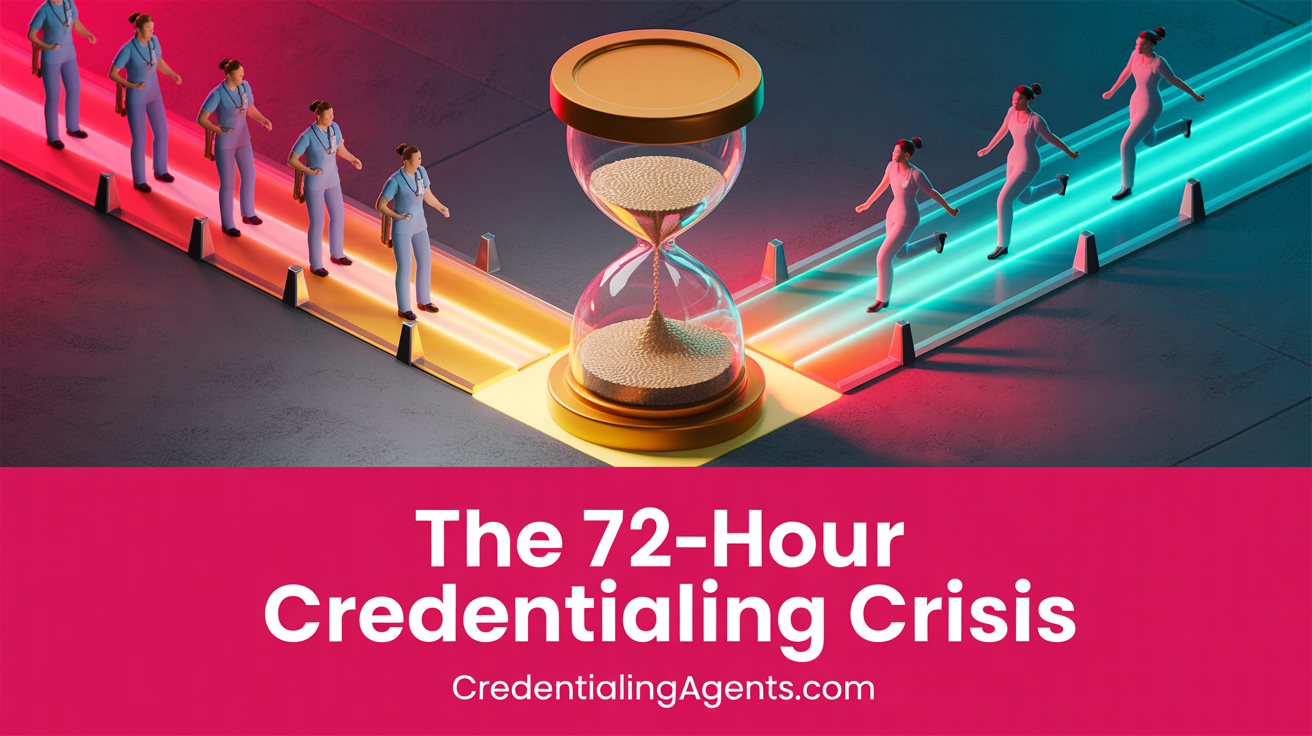
Every hour your credentialing team spends chasing documents is an hour a qualified nurse sits on the sidelines. In todays hypercompetitive healthcare staffing market, that delay isnt just inconvenient—its existential.
The Math That Should Terrify Every Staffing Agency
The average travel nurse receives 3-5 offers within 48 hours of becoming available. Yet the average credentialing process takes 14-21 days. Do the math: by the time youve verified their first certification, theyve already signed with someone faster.
This isnt a process problem. Its a survival problem.
Where 72 Hours Becomes 72 Days
Lets trace the journey of a single license verification:
- Day 1-3: Request submitted to state board
- Day 4-14: Waiting for response (assuming no backlog)
- Day 15-17: Discrepancy found, resubmission required
- Day 18-28: Second verification cycle
- Day 29+: Finally cleared—if nothing else surfaces
Multiply this by every license, certification, and background check. Now multiply by every nurse in your pipeline. The bottleneck isnt your staff. Its the system itself.
Why Manual Credentialing Is a Losing Game
Primary Source Verification (PSV) remains the gold standard for compliance. But heres the dirty secret: most agencies are still doing PSV the same way they did in 2010.
- Faxing requests to state boards
- Playing phone tag with licensing departments
- Manually cross-referencing databases
- Re-entering data across multiple systems
Each touchpoint introduces delay. Each delay costs you candidates. Each lost candidate costs you contracts.
The AI Credentialing Advantage
What if your credentialing could run 24/7 without human intervention? What if license verifications that take days could happen in minutes?
This isnt science fiction. AI-powered credentialing automation is already transforming how forward-thinking agencies operate:
- Automated PSV: Direct API connections to state licensing boards
- Intelligent document processing: OCR and NLP extract data from any document format
- Predictive expiration tracking: Know about renewals before theyre due
- Multi-state compliance: Navigate different state requirements automatically
The Compliance Paradox
Heres what most agencies get wrong: they think speed and compliance are trade-offs. Move fast, make mistakes. Be thorough, move slow.
Wrong.
AI credentialing is actually more compliant than manual processes. Why? Because:
- Every verification is timestamped and logged
- No human error in data entry
- Automatic audit trails for Joint Commission and state surveys
- Real-time monitoring catches issues before they become violations
Speed is compliance when your system never sleeps, never forgets, and never cuts corners.
What 72-Hour Credentialing Looks Like
Imagine this workflow:
Hour 0: Nurse applies through your portal
Hour 1: AI extracts all credentials from uploaded documents, initiates automated PSV for all licenses
Hour 12: Background check results returned, automatically cross-referenced
Hour 24: All state licenses verified, certifications confirmed
Hour 48: Skills checklists completed, facility-specific requirements matched
Hour 72: Nurse is fully credentialed and ready for placement
This isnt a dream. This is what happens when you stop treating credentialing as paperwork and start treating it as a competitive advantage.
The Cost of Waiting
Every day you delay modernizing your credentialing process:
- 3-5 nurses choose faster competitors
- Revenue per nurse: $15,000-$25,000 per 13-week contract
- Annual impact: Potentially millions in lost placements
Meanwhile, agencies using AI credentialing are placing nurses while youre still verifying their first license.
Making the Shift
Transforming your credentialing operation doesnt mean ripping out everything and starting over. It means strategically automating the bottlenecks:
- Start with PSV: This is where most time dies. Automate license verification first.
- Integrate your systems: No more re-keying data between platforms
- Build your audit trail: Compliance isnt optional—make it automatic
- Scale intelligently: Let AI handle volume while your team handles exceptions
The Bottom Line
The 72-hour credentialing crisis isnt coming. Its here. Agencies that adapt will dominate the market. Those that dont will wonder where all their nurses went.
The question isnt whether to modernize your credentialing. Its whether you can afford not to.
Ready to turn credentialing from your biggest bottleneck into your competitive advantage?
See how AI-powered credentialing automation works →
Credentialing Agents transforms weeks of manual verification into hours of automated compliance. Built specifically for healthcare staffing agencies ready to move at the speed their nurses demand.