The 72-Hour Credentialing Problem: Why Speed Matters in Healthcare Staffing
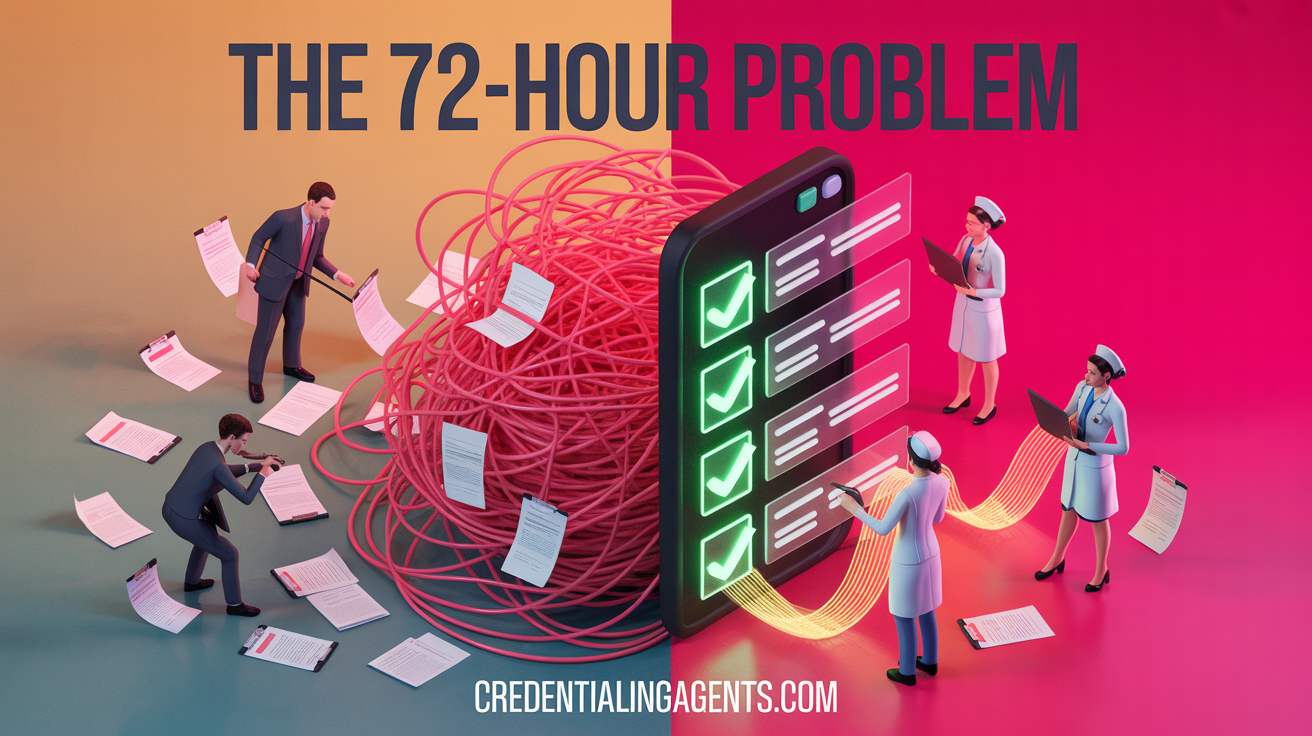
The 72-Hour Credentialing Problem: Why Speed Matters in Healthcare Staffing
Every 72 hours a travel nurse spends waiting for credentialing approval is 72 hours a hospital bed goes understaffed. In an industry where patient outcomes hang in the balance, slow credentialing is not just an administrative inconvenience—it is a critical failure point.
The Hidden Cost of Credentialing Delays
Healthcare staffing agencies know the math all too well:
- Average credentialing time: 30-90 days for traditional processes
- Revenue lost per nurse per day: $300-$600 in placement fees
- Patient care impact: Increased nurse-to-patient ratios, longer wait times, staff burnout
When a facility urgently needs an ICU nurse and your candidate is stuck in credentialing purgatory, everyone loses—the agency, the nurse, the hospital, and most importantly, the patients.
Why Traditional Credentialing Fails
The conventional credentialing process was designed for a different era:
- Manual primary source verification - Faxing requests to nursing boards, waiting weeks for responses
- Siloed databases - Each facility maintaining separate credential files
- Paper-based workflows - Documents getting lost, misfiled, or sitting in inboxes
- Human bottlenecks - Credentialing specialists juggling hundreds of files
This system cannot keep pace with modern healthcare staffing demands, especially when travel nursing assignments can begin within days of acceptance.
The AI-Powered Solution
Artificial intelligence is fundamentally reshaping credentialing operations. Here is what modern AI credentialing looks like:
Automated Primary Source Verification
AI agents can simultaneously query multiple licensing boards, certification bodies, and educational institutions—completing in hours what traditionally took weeks.
Intelligent Document Processing
Machine learning algorithms extract, validate, and cross-reference credential data from uploaded documents with near-perfect accuracy, flagging anomalies for human review.
Predictive Expiration Management
Smart systems track every license, certification, and competency—automatically initiating renewal workflows before anything lapses.
Real-Time Compliance Monitoring
Continuous monitoring ensures credentials remain valid throughout assignments, with instant alerts if status changes.
The Business Impact
Staffing agencies implementing AI-powered credentialing report:
- 70% reduction in time-to-credential
- 85% decrease in manual data entry
- 99.5% accuracy in credential verification
- 3x faster response to urgent staffing requests
Making the Transition
Moving from legacy credentialing to AI-powered systems does not require a massive overhaul. The best solutions integrate with existing workflows, enhancing rather than replacing your credentialing team.
Your specialists become credential strategists—handling complex cases and building facility relationships—while AI handles the repetitive verification work.
The Bottom Line
In healthcare staffing, speed is not just a competitive advantage—it is a patient care imperative. Every day saved in credentialing is a day a qualified nurse can be at the bedside.
The 72-hour problem is solvable. AI credentialing technology exists today, and forward-thinking agencies are already deploying it.
Ready to eliminate your credentialing bottleneck?
Credentialing Agents provides AI-powered credentialing automation built specifically for healthcare staffing. Our AI agents handle primary source verification, document processing, and compliance monitoring—so your team can focus on what matters: placing nurses where they are needed most.