The 72-Hour Credentialing Promise: Why Speed Is the New Competitive Advantage in Healthcare Staffing
In healthcare staffing, time kills deals. Every hour a nurse waits for credentialing is an hour they might accept an offer from your competitor.
The agencies winning in 2026 aren't just offering better pay or better placements—they're offering speed.
The Hidden Cost of Slow Credentialing
Let's do the math. The average healthcare staffing agency takes 21-45 days to fully credential a travel nurse. During that time:
- The nurse is interviewing with 3-5 other agencies
- Your competitors are making offers
- The facility's urgent need might get filled by someone else
- Your recruiter's time investment may yield nothing
A study by Staffing Industry Analysts found that 67% of travel nurses will accept an offer from whichever agency credentials them first—regardless of pay rate differences of up to 8%.
Speed isn't a nice-to-have. It's the ballgame.
Why Traditional Credentialing Takes So Long
The traditional credentialing process is a Rube Goldberg machine of inefficiency:
- Manual document collection — Chasing nurses for licenses, certifications, references
- Primary source verification — Calling boards, schools, and previous employers
- Compliance checklist management — Different requirements for every state and facility
- Human bottlenecks — Credentialing specialists juggling 50+ files simultaneously
Every handoff introduces delay. Every manual step introduces error. Every error requires rework.
The 72-Hour Promise: What It Takes
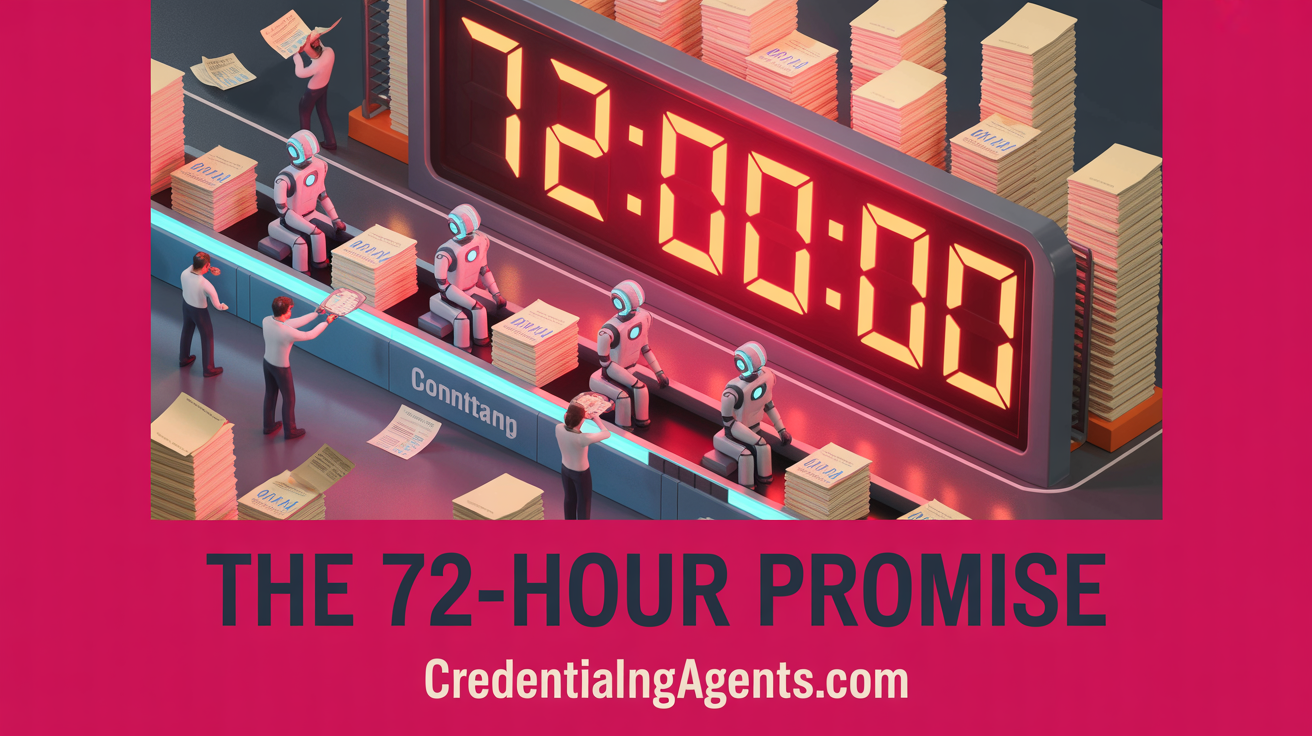
The leading agencies are now promising full credentialing in 72 hours or less. Here's how they're doing it:
1. AI-Powered Document Processing
Modern credentialing platforms use AI to automatically:
- Extract data from uploaded documents
- Verify authenticity and expiration dates
- Flag discrepancies instantly
- Route incomplete files back to nurses with specific requests
2. Automated Primary Source Verification
Instead of phone calls and faxes, AI agents can:
- Query state nursing board databases in real-time
- Verify certifications through digital registries
- Confirm employment history through integrated systems
- Complete verifications in minutes, not weeks
3. Smart Compliance Mapping
AI systems maintain current requirements for:
- All 50 states plus territories
- Major health systems and their specific requirements
- Joint Commission and CMS standards
- Compact license reciprocity rules
When requirements change, the system updates automatically—no manual policy research required.
4. Parallel Processing
Traditional credentialing is sequential: collect everything, then verify, then approve.
AI-powered systems work in parallel: the moment a BLS certification is uploaded, verification begins—while the nurse is still uploading their references.
The Competitive Moat of Speed
Agencies that achieve 72-hour credentialing don't just fill positions faster. They:
- Win more nurses — Speed is the #1 factor in nurse agency selection
- Reduce recruiter burnout — Less time chasing paperwork, more time building relationships
- Improve fill rates — Credentialed nurses are ready when opportunities arise
- Command premium rates — Facilities pay more for guaranteed fast deployment
Getting There: The Implementation Reality
You can't achieve 72-hour credentialing with manual processes and good intentions. It requires:
Technology investment — AI-powered credentialing platforms that automate 80%+ of the work
Process redesign — Eliminating sequential bottlenecks in favor of parallel workflows
Integration — Connecting to primary source databases, your ATS, and facility requirements
Change management — Training teams to work with AI, not against it
The good news: the technology exists today. The agencies investing in AI credentialing are already pulling ahead.
The Bottom Line
In 2026, credentialing speed is the single biggest differentiator in healthcare staffing. The agencies promising 72-hour turnaround—and delivering—are capturing market share from slower competitors.
The question isn't whether to modernize your credentialing process. It's whether you can afford to wait while your competitors don't.
Ready to credential nurses in hours, not weeks? Credentialing Agents uses AI to automate primary source verification, compliance tracking, and document processing—helping staffing agencies achieve the 72-hour promise.