The 72-Hour Credentialing Sprint: How AI Is Transforming Urgent Healthcare Placements
In healthcare staffing, time kills deals. Every hour a credentialing file sits incomplete is an hour your travel nurse isn't billing, your client is understaffed, and your competitor is closing the placement you should have won.
The dirty secret of traditional credentialing? It takes 30-60 days. Sometimes longer. In a market where hospitals need nurses yesterday, that timeline is a death sentence for revenue.
The Anatomy of Credentialing Delay
Let's break down where the time actually goes:
- Primary source verification (PSV): 7-14 days waiting for state boards, NPDB, and educational institutions to respond
- Document collection: 5-10 days chasing candidates for missing immunization records, certifications, and license copies
- Data entry: 2-3 days manually keying information into credentialing systems
- Review and QA: 2-5 days for compliance teams to review and approve files
- Facility-specific requirements: Another 3-7 days for MSA uploads and client credentialing portals
Add it up, and you're looking at 20-40+ days in the best case scenario. Miss one document? Start the clock over.
The 72-Hour Promise
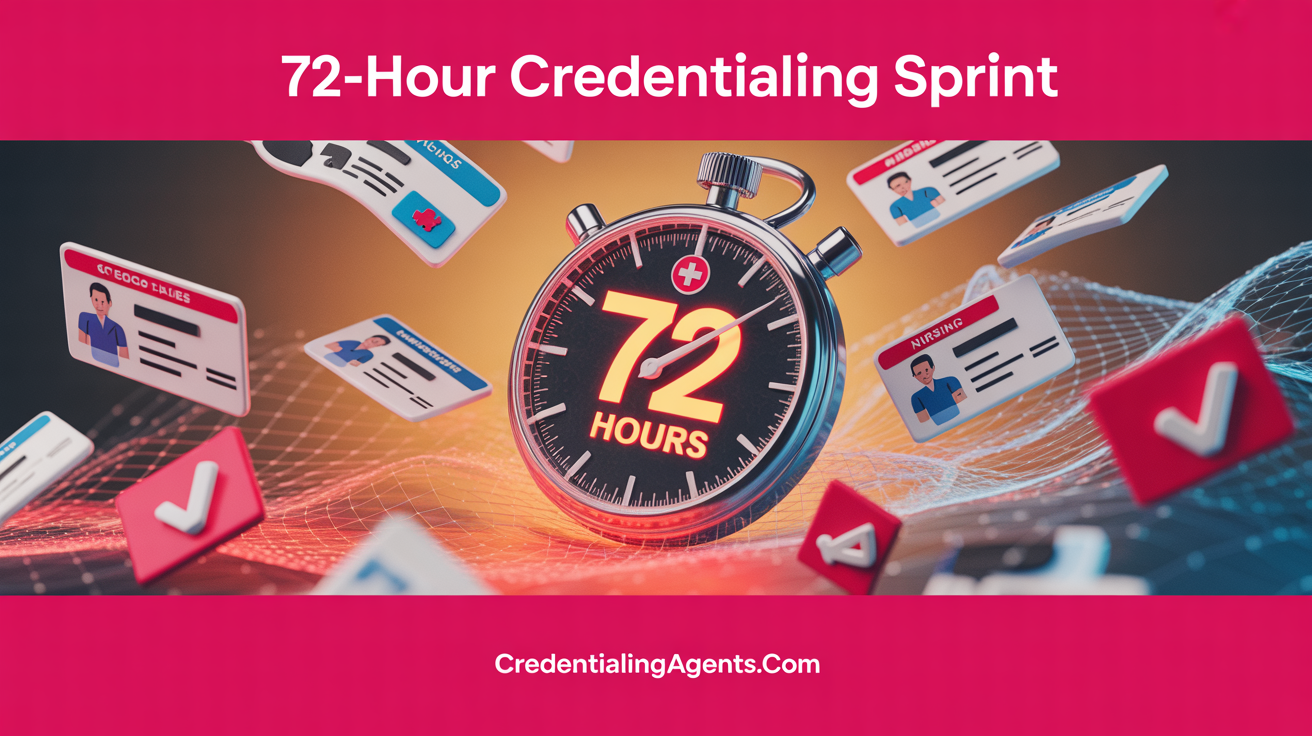
What if you could collapse that entire timeline into 72 hours?
Not through cutting corners. Not through skipping verifications. But through intelligent automation that works 24/7, never forgets a follow-up, and catches discrepancies before they become compliance nightmares.
This is what AI-powered credentialing delivers:
Automated Primary Source Verification
AI agents can simultaneously query state nursing boards, the NPDB, OIG exclusion lists, and educational verification services. What used to require manual lookups across dozens of portals now happens in parallel—often returning results in hours, not weeks.
Intelligent Document Collection
Instead of generic email reminders that get ignored, AI systems analyze exactly what's missing from each candidate's file and send targeted, urgent communications. They know when a BLS certification expires in 30 days and proactively request renewals.
Real-Time Discrepancy Detection
Manual credentialing catches errors at the end—after days of work. AI catches them immediately. Name doesn't match the license? Social Security number has a transposition error? Flagged in seconds, not discovered during final QA.
Parallel Processing at Scale
A human credentialing coordinator can work on maybe 20-30 files at once. An AI system can manage thousands simultaneously, each one progressing at maximum possible speed.
The Revenue Impact
Let's do the math:
- Average travel nurse bill rate: $85/hour
- Hours per week: 36-48
- Weeks lost to credentialing delays: 2-4
Revenue delayed per nurse: $6,120 - $16,320
Multiply that across your candidate pipeline. If you're placing 50 nurses per month and shaving even one week off credentialing time, that's $153,000 - $408,000 in accelerated revenue annually.
Not to mention the placements you didn't lose to competitors who could move faster.
The Compliance Advantage
Speed without accuracy is a liability. The Joint Commission doesn't care how fast you credentialed someone if the file is incomplete.
AI-powered credentialing actually improves compliance:
- 100% verification coverage: No more "we forgot to check the NPDB" incidents
- Audit-ready documentation: Every verification timestamped and logged
- Expiration tracking: Automatic alerts before licenses and certifications lapse
- Sanction monitoring: Continuous screening, not just at hire
The fastest credentialing is also the most thorough. AI doesn't get tired. It doesn't skip steps on a busy Friday afternoon. It doesn't forget to check that one obscure state board.
Making the Transition
Moving from 30-day credentialing to 72-hour credentialing isn't just a technology upgrade—it's an operational transformation. Here's what it requires:
Process mapping: Document every step of your current workflow. Where are the bottlenecks? What's waiting on humans that could be automated?
Integration architecture: AI credentialing works best when connected directly to your ATS, VMS clients, and verification sources. API-first platforms beat manual uploads.
Exception handling: Define what still requires human review. Sanctions hits, license restrictions, gaps in employment—these need escalation workflows.
Metrics and monitoring: Track time-to-credential, error rates, and completion percentages. What gets measured improves.
The Competitive Moat
In healthcare staffing, margins are tight and competition is fierce. Speed-to-credential is becoming the differentiator that separates market leaders from everyone else.
When a hospital calls with an urgent need, the agency that can say "we'll have a fully credentialed nurse ready in 72 hours" wins the business. Every time.
AI credentialing isn't just about efficiency—it's about building an operational capability your competitors can't match.
Ready to Transform Your Credentialing Operations?
Credentialing Agents delivers AI-powered credentialing automation purpose-built for healthcare staffing agencies. Collapse your credentialing timeline from weeks to days, improve compliance accuracy, and unlock the revenue stuck in your pipeline.