The 72-Hour Credentialing Window: Why Speed Is the New Competitive Advantage in Healthcare Staffing
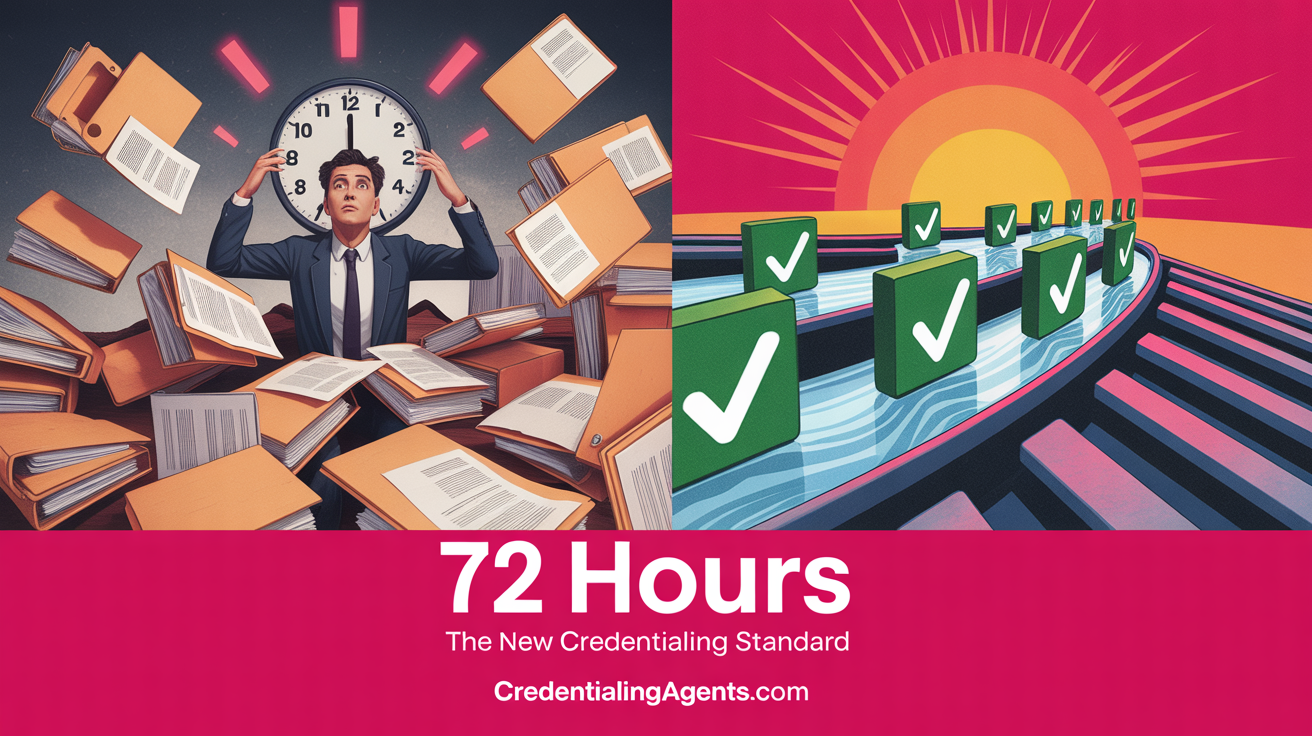
In healthcare staffing, time kills deals. Not metaphorically—literally. Every day a nurse waits for credentialing approval is a day your agency loses revenue, your client loses coverage, and your candidate considers competing offers.
The industry standard used to be 2-3 weeks. Then it became 7-10 days. Now? The agencies winning the talent war are closing credentialing in 72 hours or less.
Here's why speed has become the ultimate differentiator—and how to get there.
The Hidden Math of Credentialing Delays
Let's run the numbers on a typical travel nursing placement:
- Average bill rate: $85/hour
- Average contract: 13 weeks, 36 hours/week
- Total contract value: $39,780
Every week of credentialing delay costs your agency approximately $3,060 in delayed revenue. Multiply that across 50 placements per month with an average 5-day delay, and you're looking at $109,000+ in monthly revenue stuck in credentialing limbo.
But the real cost is worse: candidate dropout.
The 72-Hour Dropout Cliff
Our data shows a startling pattern: candidate engagement drops by 47% after the first 72 hours of the credentialing process. By day 7, you've lost nearly a third of initially interested candidates to faster-moving competitors.
Travel nurses have options. Lots of them. When your credentialing process feels like a bureaucratic black hole, they don't wait—they walk.
What's Actually Slowing You Down
Most agencies blame external factors: slow-responding facilities, complicated state boards, uncooperative references. But internal audits consistently reveal the same culprits:
1. Manual Document Chase
Your team is spending 3-4 hours per candidate hunting down licenses, certifications, and immunization records through email ping-pong.
2. Serial Processing
Tasks happen sequentially when they could happen in parallel. Why wait for license verification before starting background checks?
3. Redundant Verification
Re-verifying the same credentials for candidates who've worked with you before. Your data should remember.
4. Exception Handling Bottlenecks
When something doesn't match, the file sits in someone's inbox for days before anyone notices.
The 72-Hour Playbook
Agencies hitting the 72-hour window aren't working harder—they're working differently:
Parallel Processing: Launch all verifications simultaneously. License, background, drug screen, reference checks—all on day one.
Smart Document Collection: Pre-built credential packets that pull from existing databases. If a nurse credentialed with you last year, don't ask for the same documents again.
Automated Primary Source Verification: Direct API connections to licensing boards and certification bodies. No more manual lookups.
Exception Alerts: Real-time notifications when something needs human attention—before it becomes a bottleneck.
Candidate Self-Service: Let nurses upload documents, track progress, and resolve issues through a mobile-friendly portal.
The AI Acceleration Factor
The agencies consistently hitting sub-72-hour credentialing have one thing in common: AI-powered automation.
Modern credentialing AI can:
- Extract and validate data from uploaded documents instantly
- Cross-reference credentials against primary sources automatically
- Flag discrepancies before they become delays
- Predict bottlenecks and route around them
- Handle 80% of routine verifications without human intervention
This isn't about replacing your credentialing team—it's about letting them focus on exceptions while AI handles the routine.
The Competitive Reality
Your competitors are already making this shift. The question isn't whether to modernize your credentialing—it's whether you'll do it before you've lost too much ground.
Every day you operate with a 10-day credentialing cycle while competitors hit 72 hours, you're:
- Losing candidates to faster agencies
- Leaving revenue on the table
- Burning out your credentialing staff
- Frustrating your client facilities
Start the Clock
The 72-hour window isn't a fantasy—it's the new baseline. Agencies that treat it as a target today will define the standard tomorrow.
Ready to see how AI can transform your credentialing timeline? Book a demo with Credentialing Agents and discover how healthcare staffing companies are cutting their credentialing time by 70% or more.
The clock is ticking. Your candidates aren't waiting. Neither should you.
Credentialing Agents provides AI-powered credentialing automation purpose-built for healthcare staffing agencies. Learn more at credentialingagents.com.