The 90-Day Credentialing Bottleneck: How AI is Turning Weeks into Hours
Why healthcare staffing agencies are losing millions to outdated credentialing processes—and the AI revolution changing everything
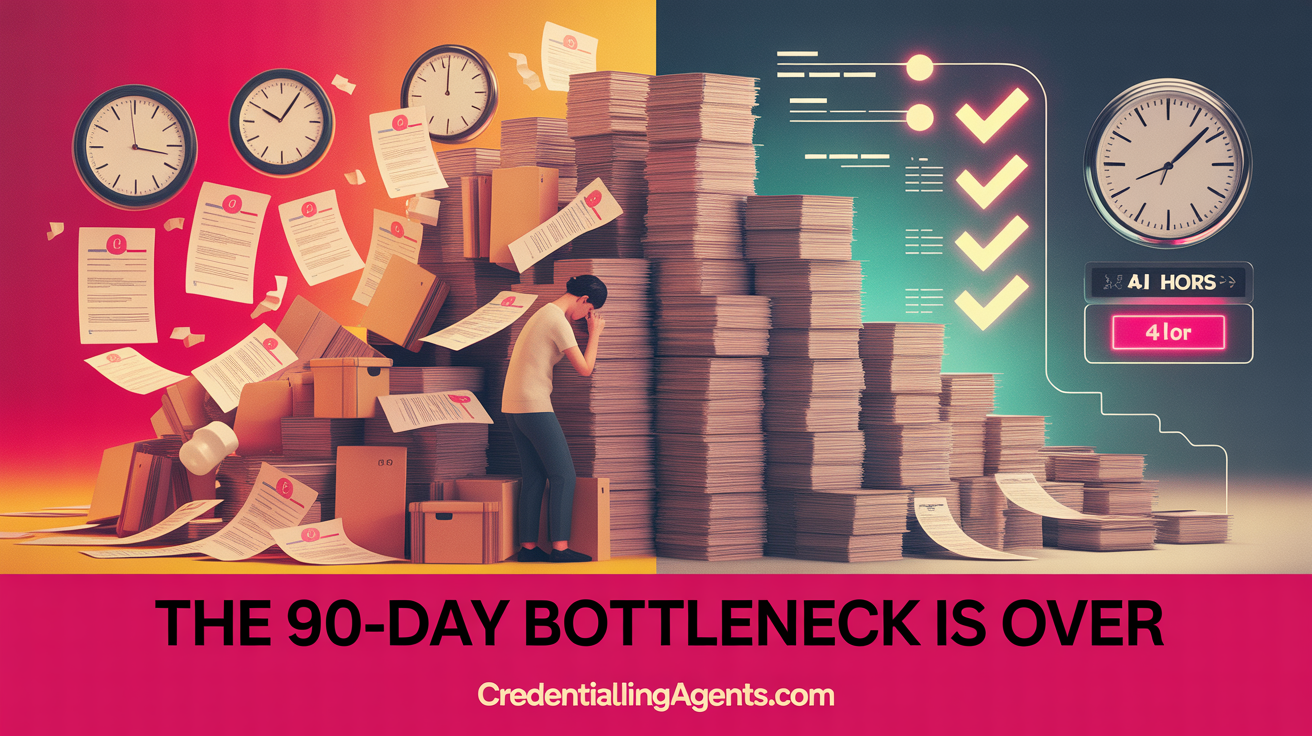
Every healthcare staffing agency knows the frustration: a highly qualified travel nurse is ready to work, a hospital desperately needs coverage, but the credentialing process grinds everything to a halt.
The average time to credential a single healthcare professional? 90+ days.
That is not a typo. In an industry where every unfilled shift costs hospitals thousands of dollars and every delayed placement costs agencies revenue, we are still operating on timelines that belong in the fax machine era.
The Hidden Cost of Manual Credentialing
Let us break down what happens during those 90 days:
- Primary source verification of licenses (contacting state boards, waiting for responses)
- Education verification (reaching out to nursing schools, often with 2-3 week turnaround times)
- Employment history verification (playing phone tag with HR departments)
- Certification validation (BLS, ACLS, specialty certifications)
- Background checks and drug screenings (more waiting)
- Immunization and health records (chasing down documentation)
- Facility-specific requirements (each hospital has its own checklist)
A single credentialing specialist can reasonably manage 40-60 active files at a time. When each file requires dozens of follow-up calls, emails, and manual data entry, bottlenecks are inevitable.
The result? Nurses waiting unpaid. Hospitals understaffed. Agencies leaving revenue on the table.
Why Traditional Credentialing Software Falls Short
Most credentialing platforms on the market today are essentially glorified checklists. They help you track what needs to be done, but they do not actually do the work.
You still need humans to:
- Pick up the phone and call state boards
- Email nursing schools and wait for responses
- Manually enter data from faxed documents
- Chase down missing information from candidates
- Re-verify everything when credentials expire
This is not process improvement. This is process documentation.
Enter AI-Powered Credentialing
The paradigm shift happening right now is not about better checklists—it is about intelligent automation that actually executes the credentialing workflow.
What AI Credentialing Looks Like in Practice
Automated Primary Source Verification AI agents can interface directly with state licensing boards, NURSYS databases, and verification services—24/7, without coffee breaks or phone tag. What used to take 2-3 weeks now happens in hours.
Intelligent Document Processing When a nurse uploads their certifications, AI extracts the relevant data, validates authenticity, and flags any discrepancies—instantly. No more manual data entry errors or overlooked expirations.
Proactive Expiration Management Instead of scrambling when licenses expire, AI systems monitor upcoming expirations and initiate renewal workflows automatically. Your nurses stay compliant without the fire drills.
Smart Exception Handling AI does not just follow scripts. Modern systems can identify when something unusual comes up (a state board under new management, a school that changed its verification process) and adapt accordingly—or escalate to humans only when truly necessary.
The Numbers That Matter
Agencies implementing AI-powered credentialing are seeing:
- Time-to-placement reduced from 90 days to under 2 weeks
- Credentialing staff capacity increased 3-5x
- Compliance error rates dropping to near-zero
- Candidate satisfaction scores increasing 40%+
When you can get nurses placed faster, you bill faster. When your staff handles more files, you scale without proportional headcount increases. When compliance is airtight, you avoid costly penalties and audit failures.
The Competitive Advantage Window
Here is the uncomfortable truth: your competitors are looking at this same technology right now.
The agencies that move first will:
- Place nurses faster and win more contracts
- Operate leaner and maintain better margins
- Build reputations for reliability and speed
- Attract top nursing talent who are tired of waiting
The agencies that wait will wonder why their best candidates are going elsewhere.
Making the Transition
Adopting AI credentialing does not mean firing your credentialing team. It means transforming them from data-entry clerks into strategic operators who handle the truly complex cases while AI handles the routine 80%.
The best implementations:
- Start with a pilot program on a subset of credentials
- Measure baseline metrics (time-to-clear, cost-per-credential, error rates)
- Run parallel processes initially to build confidence
- Scale based on results, not hype
The Bottom Line
The 90-day credentialing bottleneck is not inevitable. It is a choice.
Every day you wait to modernize is another day of:
- Lost placements
- Frustrated nurses
- Understaffed hospitals
- Revenue left on the table
AI credentialing is not coming. It is here. The only question is whether you will be the disruptor or the disrupted.
Ready to see what AI-powered credentialing can do for your agency?
Book a demo at CredentialingAgents.com and discover how leading staffing agencies are cutting credentialing time by 85% while improving compliance accuracy.
The future of healthcare credentialing is not about working harder. It is about working intelligently.