From 45 Days to 4 Hours: How AI Is Eliminating Credentialing Bottlenecks in Healthcare Staffing
The average healthcare credentialing process takes 45 days. For travel nurses waiting on assignments, that's 45 days of lost income. For staffing agencies, it's 45 days of frustrated clients and delayed placements. For hospitals facing critical shortages, it's 45 days of understaffing.
But what if you could compress that timeline to just a few hours?
The Credentialing Crisis Nobody Talks About
Healthcare staffing is projected to face a shortage of 1.1 million nurses by 2030. Yet even with willing, qualified candidates ready to work, outdated credentialing processes create artificial bottlenecks that slow placements to a crawl.
The problem isn't a lack of qualified talent—it's the mountain of paperwork standing between clinicians and patient care.
Consider what a typical credentialing coordinator faces:
- Primary source verification across dozens of institutions
- License verification in multiple states
- Background checks and sanctions screening
- Education verification from nursing schools
- Work history confirmation with previous employers
- Reference checks that go unanswered for weeks
- Expiring documents that need constant monitoring
Multiply this by hundreds of candidates, and you've got a recipe for burnout, errors, and endless delays.
Why Traditional Credentialing Fails
Most healthcare staffing agencies still rely on manual processes that haven't fundamentally changed in decades:
1. Phone Tag and Fax Machines
Yes, fax machines. In 2026, credentialing coordinators still spend hours calling medical schools, waiting on hold with licensing boards, and hunting down references who don't respond to voicemails.
2. Spreadsheet Chaos
Tracking hundreds of expiring licenses, certifications, and documents in Excel is a disaster waiting to happen. One missed renewal can pull a nurse off assignment and expose your agency to compliance risk.
3. Human Error at Scale
When you're processing dozens of credentialing files simultaneously, mistakes are inevitable. A transposed digit, a missed sanction, an overlooked exclusion—these errors can have serious consequences.
4. No Standardization
Every hospital and healthcare system has slightly different requirements. Managing these variations manually creates exponential complexity.
Enter AI-Powered Credentialing
Artificial intelligence is fundamentally transforming how healthcare staffing agencies approach credentialing. Here's what's now possible:
Automated Primary Source Verification
AI agents can simultaneously query licensing boards, educational institutions, and certification bodies—completing in minutes what used to take days of manual effort.
Intelligent Document Processing
Modern AI can extract, validate, and organize information from uploaded documents instantly. No more manual data entry. No more transcription errors.
Predictive Expiration Management
Smart systems track every credential expiration and proactively alert you before anything lapses—eliminating the compliance nightmares that keep staffing managers up at night.
Real-Time Sanctions Monitoring
Continuous monitoring of OIG, SAM, and state exclusion databases means you're never caught off guard by a sanctioned provider.
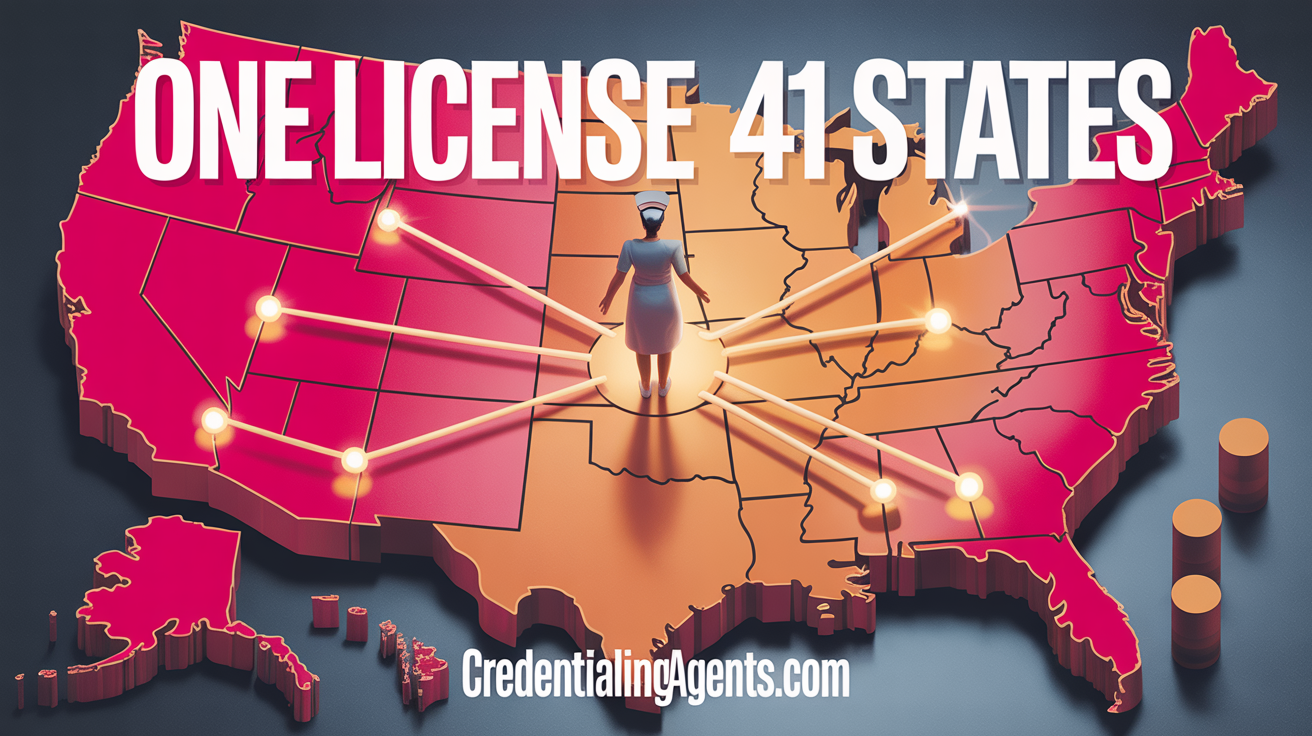
Multi-State Compliance Mapping
AI can instantly determine what's needed for each placement, automatically adapting to the specific requirements of each facility and state.
The ROI of Speed
Faster credentialing isn't just about convenience—it's about competitive advantage:
- Higher fill rates: Place candidates before competitors
- Better talent retention: Nurses don't wait around for slow agencies
- Reduced overhead: Fewer coordinators managing more candidates
- Lower compliance risk: Automated tracking catches what humans miss
- Improved client satisfaction: Faster placements mean happier hospitals
The Human Element Still Matters
AI doesn't replace credentialing professionals—it amplifies them. Your team's expertise in navigating complex compliance scenarios, building relationships with facilities, and making nuanced judgment calls remains essential.
What changes is that they're no longer drowning in administrative busywork. Instead of chasing down verification calls, they're solving actual problems and focusing on high-value activities.
Making the Transition
If your agency is still running on manual credentialing processes, the gap between you and AI-enabled competitors grows every day. The good news? Transitioning doesn't require ripping out your existing systems.
Modern credentialing AI solutions integrate with your current workflows, augmenting rather than replacing what you've built.
The Future Is Already Here
Healthcare staffing agencies that embrace AI-powered credentialing today will dominate the market tomorrow. Those that don't will find themselves losing talent, clients, and competitive position to faster-moving competitors.
The choice is clear: 45 days or 4 hours?
Ready to eliminate your credentialing bottleneck? Credentialing Agents uses AI to automate the entire credentialing lifecycle—from document collection to primary source verification to ongoing compliance monitoring. See how leading staffing agencies are cutting credentialing time by 90% or more.