From 30 Days to 72 Hours: How AI-Powered Credentialing Is Transforming Healthcare Staffing Speed
From 30 Days to 72 Hours: How AI-Powered Credentialing Is Transforming Healthcare Staffing Speed
In healthcare staffing, time is more than money—it's patient care. Every day a qualified nurse or allied health professional sits waiting for credentialing approval is a day your facility runs short-staffed, your agency loses revenue, and your candidates consider other offers.
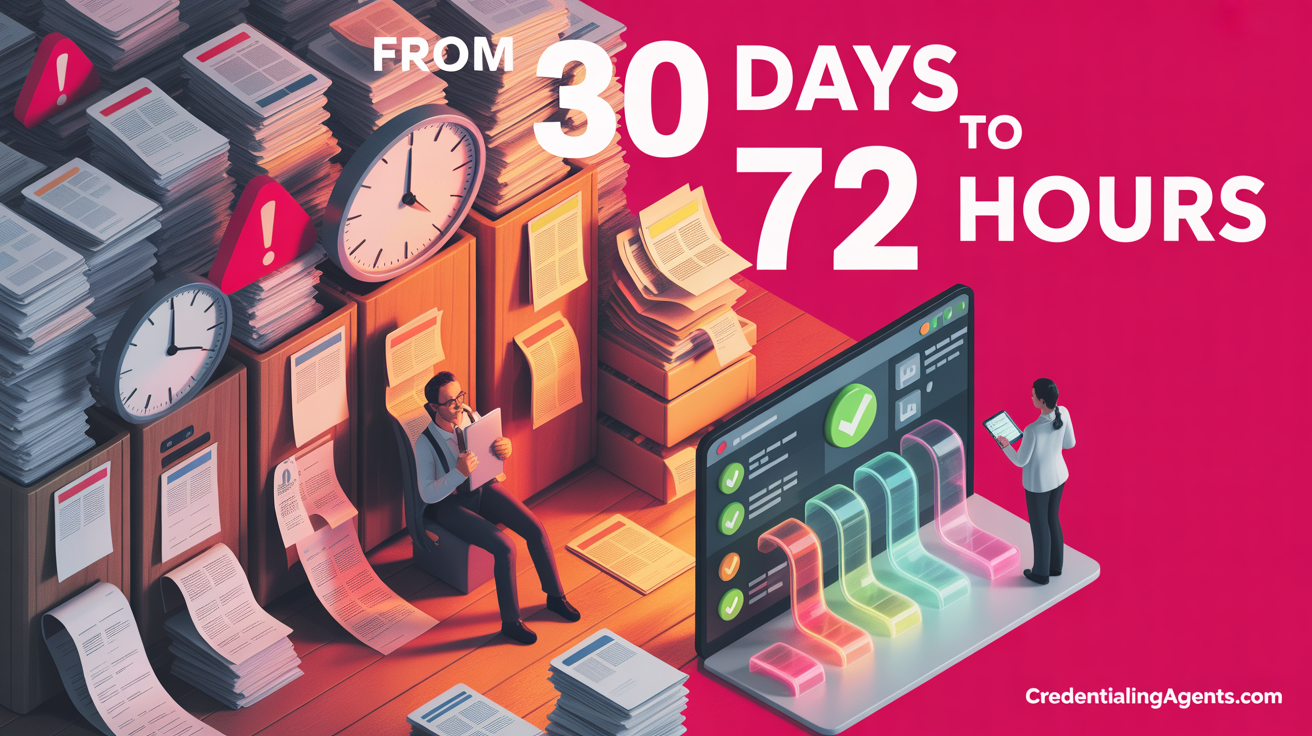
The traditional credentialing timeline? 30+ days on average. The new reality with AI? 72 hours or less.
Here's how the transformation is happening.
The Bottleneck Nobody Talks About
Healthcare staffing agencies face a brutal paradox: they have qualified candidates ready to work and facilities desperate for staff, but the credentialing process creates a black hole in between.
Consider what manual credentialing actually involves:
- Primary source verification for licenses across multiple states
- Background check coordination with varying turnaround times
- Skills checklist validation against facility-specific requirements
- Compliance document collection (immunizations, certifications, TB tests)
- Reference checks that require phone tag with former supervisors
- Facility-specific onboarding documentation
Traditionally, a credentialing coordinator juggles 50-100 files simultaneously, manually checking status on each, following up on missing documents, and hoping nothing falls through the cracks.
Spoiler: things always fall through the cracks.
What 30 Days Actually Costs You
Let's do the math on a single travel nurse placement:
- Bill rate: $85/hour
- Hours per week: 36
- Weekly revenue: $3,060
- Revenue lost per week of credentialing delay: $3,060
If your average credentialing takes 4 weeks instead of 1, that's $9,180 in delayed revenue per placement. Multiply that by 100 placements per month, and you're looking at nearly $1 million in annual revenue drag from credentialing inefficiency alone.
And that's before calculating:
- Candidates who accept competing offers during the wait
- Facilities that fill positions with other agencies
- Staff burnout from manual follow-up workload
The AI Credentialing Revolution
AI-powered credentialing platforms are collapsing the timeline by automating the three biggest time sinks:
1. Intelligent Document Processing
Instead of manually reviewing uploaded documents, AI systems can:
- Extract and validate license numbers, expiration dates, and issuing authorities
- Cross-reference against primary source databases in real-time
- Flag discrepancies before they become compliance issues
- Auto-populate facility-specific forms from existing data
2. Predictive Compliance Tracking
Rather than reactive "your license expired" alerts, AI systems proactively:
- Monitor expiration dates across all credentials
- Calculate processing times needed for renewals
- Trigger renewal workflows at the optimal time
- Predict compliance gaps before they occur
3. Automated Primary Source Verification
The biggest time killer in credentialing is waiting for external verification. AI platforms:
- Integrate directly with state nursing boards and verification databases
- Queue verifications automatically when documents are uploaded
- Track verification status across multiple sources simultaneously
- Escalate delays with appropriate follow-up
Real Results: The 72-Hour Timeline
Here's what a compressed credentialing timeline looks like with AI:
Hour 0-4: Document Collection
- Candidate receives mobile-friendly intake forms
- AI pre-fills known information from previous placements
- Smart prompts guide document uploads
- Real-time validation catches errors immediately
Hour 4-24: Automated Verification
- License verification requests submitted to primary sources
- Background check initiated
- AI cross-references facility requirements
- Missing items flagged and communicated to candidate
Hour 24-48: Processing & Review
- Verification results automatically compiled
- Compliance checklist auto-populated
- Exception items routed to human reviewers
- Facility-specific packets assembled
Hour 48-72: Final Clearance
- Human review of AI-flagged exceptions only
- Final compliance sign-off
- Credential packet delivered to facility
- Candidate cleared to start
The Human Element Isn't Going Away
Let's be clear: AI isn't replacing credentialing professionals. It's elevating them.
Instead of spending 80% of their time on data entry and follow-up emails, credentialing coordinators can focus on:
- Complex exception handling that requires human judgment
- Candidate support during the onboarding experience
- Facility relationship management for credentialing requirements
- Compliance strategy and process improvement
The agencies winning the talent war aren't the ones with the most credentialing staff—they're the ones with the smartest credentialing systems.
Getting Started: The Path to 72 Hours
If your credentialing timeline is measured in weeks rather than hours, here's how to begin the transformation:
- Audit your current process — Map every step and identify where time actually goes
- Identify automation opportunities — Document collection, verification, and tracking are prime targets
- Evaluate AI platforms — Look for healthcare-specific solutions with primary source integrations
- Start with a pilot — Test the new process with a subset of placements
- Measure and iterate — Track time-to-credential and adjust
The Bottom Line
In a market where facilities need staff yesterday and candidates have multiple offers, credentialing speed is a competitive advantage.
The agencies that figure out how to compress 30 days into 72 hours will:
- Place more candidates faster
- Reduce revenue leakage from delays
- Improve candidate experience and retention
- Free staff for higher-value work
The transformation isn't coming. It's here.
Ready to transform your credentialing operations? Credentialing Agents uses AI to automate healthcare credentialing, cutting your time-to-placement from weeks to days. See how it works at credentialingagents.com.