Beyond the License: Why Skills Checklists Are the Missing Link in Healthcare Credentialing
Your nurses have licenses. But can they actually do the job? Competency verification is where credentialing meets reality.
Beyond the License: Why Skills Checklists Are the Missing Link in Healthcare Credentialing
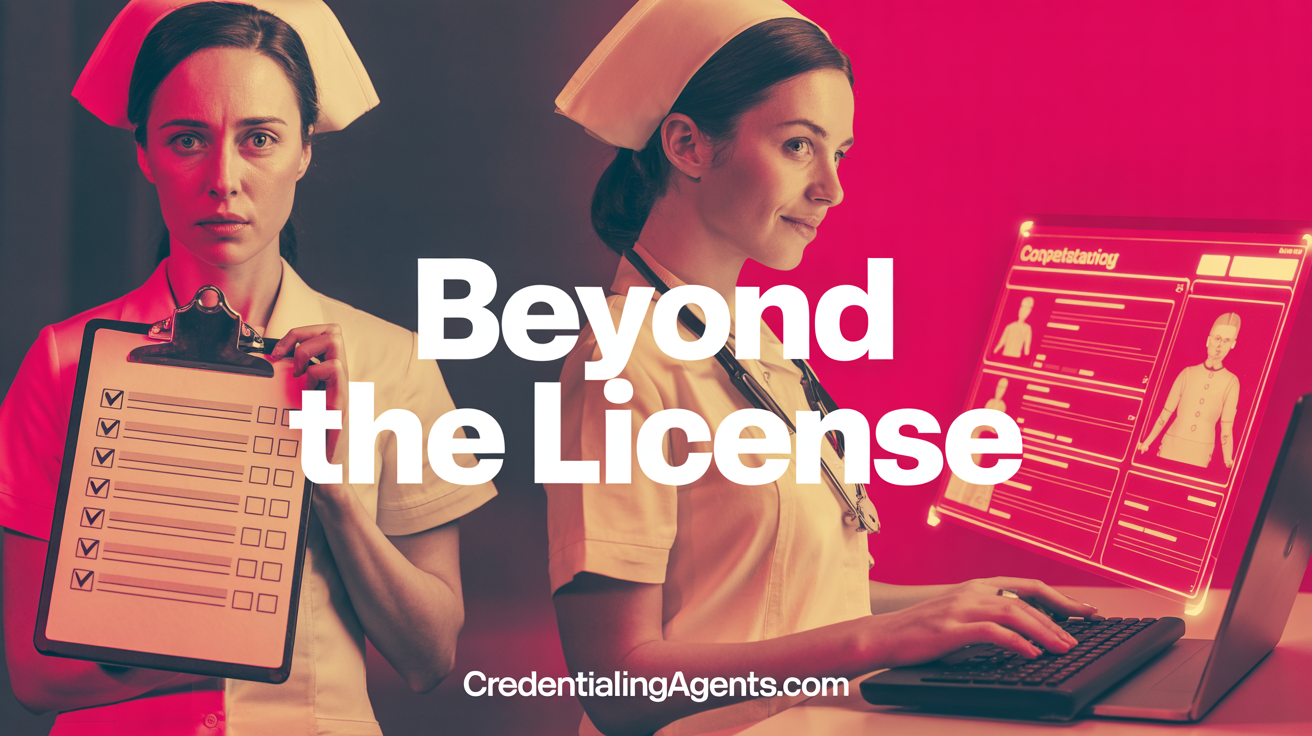
Every healthcare staffing agency knows the drill: verify the license, check the certifications, run the background check, confirm malpractice history. Box checked, nurse deployed.
But here's the uncomfortable truth that keeps quality managers up at night: a license proves someone passed an exam years ago. It doesn't prove they can start an IV on a dehydrated 90-year-old, manage a ventilator alarm at 3 AM, or handle a code blue without freezing.
Welcome to the world of skills checklists and competency verification—the often-overlooked frontier of healthcare credentialing that separates agencies that place warm bodies from agencies that place qualified professionals.
The License Is Just the Beginning
Nursing licenses are binary. You have one, or you don't. But nursing competency exists on a spectrum that no state board can measure.
Consider the travel nurse with an active RN license in 15 states through the Nurse Licensure Compact. Impressive credential portfolio. But has she worked a cardiac step-down unit in the last three years? Can she troubleshoot a Baxter infusion pump? Does she know the difference between your facility's code blue protocol and the one she learned a decade ago?
The license answers: "Is this person legally allowed to practice?"
The skills checklist answers: "Can this person actually do the job we're hiring them for?"
These are fundamentally different questions, and conflating them is how patient safety incidents happen.
The Anatomy of a Skills Checklist
A proper skills checklist isn't a formality—it's a clinical roadmap. For a typical med-surg travel nurse placement, you're looking at 50-100+ discrete competencies spanning:
- Clinical procedures: IV insertion, catheter care, wound management, medication administration routes
- Equipment proficiency: Specific pump models, monitoring systems, EHR platforms
- Specialty knowledge: Telemetry interpretation, post-op protocols, isolation precautions
- Emergency response: Code participation, rapid response procedures, emergency medication administration
- Population-specific skills: Pediatric vs. geriatric care, bariatric patients, behavioral health
Each item typically requires self-assessment (novice/competent/proficient/expert) plus validation method (education, demonstration, clinical experience).
Why Agencies Cut Corners (And Why It's a Terrible Idea)
Let's be honest: thorough competency verification takes time. Time your recruiters don't have when there's a hot job order and three agencies competing for the same placement.
The temptation to rubber-stamp skills checklists is real. "She's been a nurse for 15 years—of course she knows how to read telemetry."
Until she doesn't. Until there's an incident. Until the facility asks for documentation that the nurse was competent to perform the procedure in question.
Suddenly that time-saving shortcut becomes:
- A terminated contract
- A facility that will never work with you again
- A potential malpractice situation with your agency's name attached
- Joint Commission scrutiny for your client
The math is simple: spending 30 extra minutes on competency verification beats spending 30 hours on incident response.
The Technology Gap
Here's what's maddening: most staffing agencies have robust systems for license verification, OIG exclusion checks, and background screening. These processes are automated, integrated, and efficient.
But skills checklists? Still living in the Stone Age:
- PDF forms emailed back and forth
- Self-attestation with no validation
- Manual data entry into spreadsheets
- No integration with facility-specific requirements
- No tracking of which competencies expire or need refreshing
The disconnect is staggering. We've automated everything except the thing that actually determines whether a nurse can do the job.
What Modern Competency Verification Looks Like
Forward-thinking agencies are rethinking skills validation from the ground up:
Dynamic skills libraries: Instead of one generic checklist, maintain competency requirements mapped to specific facility types, units, and specialties. A nurse going to a Level 1 trauma center needs different validation than one going to a rural critical access hospital.
Tiered validation methods: Self-attestation for low-risk skills, manager/preceptor validation for moderate-risk, and hands-on demonstration or simulation for high-risk procedures.
Continuous competency tracking: Skills aren't static. A nurse who was proficient in ECMO three years ago needs revalidation. Modern systems track competency "freshness" and flag when updates are needed.
Facility crosswalks: Automatically map your agency's competency data to each facility's specific requirements, identifying gaps before assignment—not after.
AI-assisted verification: Pattern recognition that flags inconsistencies (claimed expert-level competency but no recent experience in that specialty) and suggests targeted validation questions.
The Compliance Imperative
Joint Commission standards are clear: healthcare organizations are responsible for verifying that staff—including contract staff—are competent to perform their assigned duties. This responsibility doesn't disappear just because the worker has a staffing agency between them and the facility.
Increasingly, facilities are pushing competency verification requirements upstream to their staffing partners. They want documentation. They want specificity. They want assurance that the nurse showing up Monday morning can actually handle their patient population.
Agencies that can't deliver this level of verification will find themselves locked out of the most demanding (and highest-margin) placements.
The Competitive Advantage
Here's the flip side: while most agencies treat skills checklists as a compliance burden, the smart ones treat them as a competitive weapon.
When you can tell a facility, "Our competency verification system has already validated this nurse against your specific unit requirements, and here's the documentation," you're not just filling an order. You're solving a problem. You're reducing their risk. You're earning the premium rates.
Moving Forward
The credentialing world is finally waking up to what clinical leaders have known forever: the license is necessary but not sufficient.
As AI transforms credentialing automation, the next frontier isn't faster license verification—it's smarter competency validation. Systems that understand what nurses actually need to know. Validation processes that are rigorous but not burdensome. Documentation that gives facilities confidence and protects agencies from liability.
The agencies that figure this out will own the quality tier of healthcare staffing. The ones that don't will compete on price for placements where competency is an afterthought.
Choose wisely.
Ready to transform your credentialing from checkbox compliance to competitive advantage? Credentialing Agents is building the future of AI-powered healthcare credentialing—including next-generation competency verification that goes beyond the license.
Visit credentialingagents.com to learn how we're helping healthcare staffing agencies credential faster, smarter, and more completely.