The CAQH Conundrum: Why Healthcare's "Universal" Credentialing Database Falls Short for Staffing Agencies
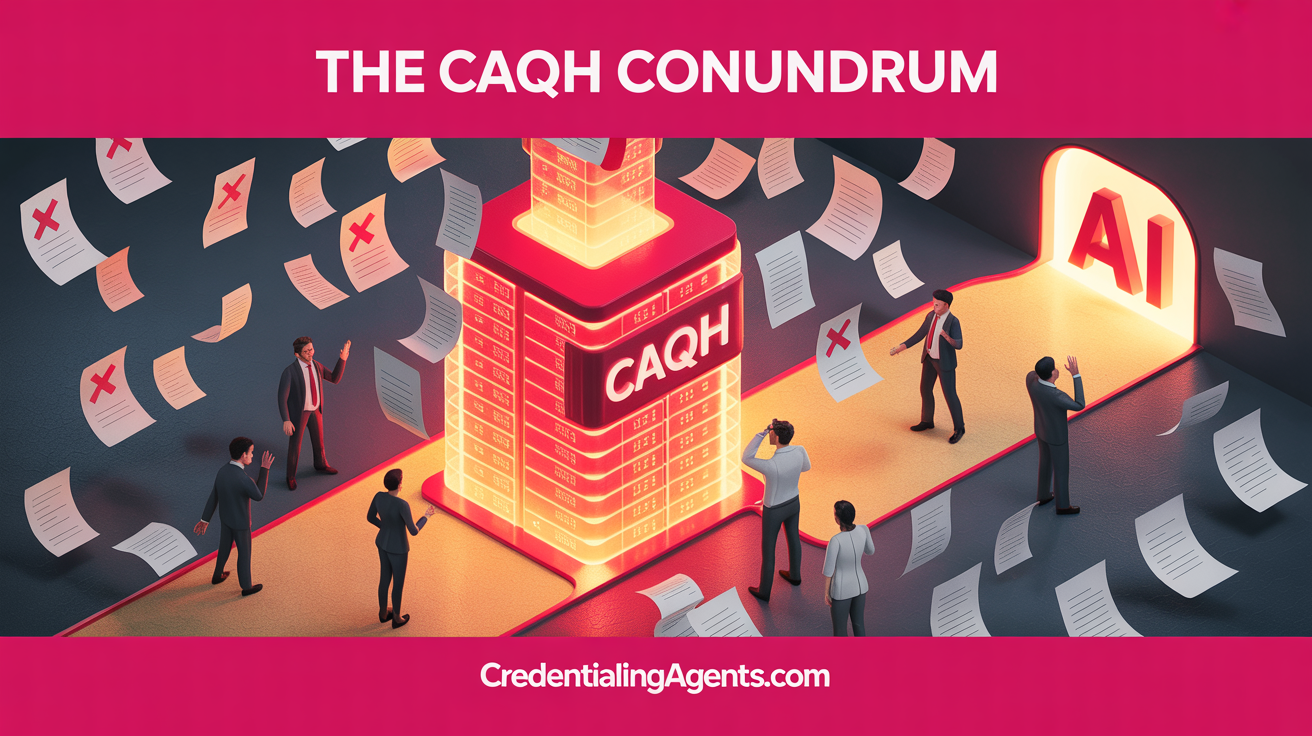
Healthcare staffing agencies were promised a silver bullet. CAQH ProView—the Council for Affordable Quality Health Care's provider data repository—was supposed to be the industry's universal credentialing database. One profile, countless verifications, zero redundancy.
The reality? For staffing agencies placing nurses, allied health professionals, and physicians across multiple facilities, CAQH has become as much a source of frustration as it is a solution.
The Promise vs. The Reality
CAQH ProView stores credentialing data for over 1.8 million healthcare providers. In theory, when a staffing agency needs to credential a provider, they simply pull verified data from the centralized repository.
Here's what actually happens:
Data Decay Is Rampant. Providers are responsible for re-attesting their CAQH profiles every 120 days. But with an estimated 30% of profiles containing outdated information at any given time, staffing agencies find themselves re-verifying data they assumed was current.
Incomplete Coverage. CAQH was designed primarily for physicians and advanced practice providers. Nurses, the backbone of healthcare staffing, have limited CAQH integration. Allied health professionals—physical therapists, occupational therapists, respiratory therapists—are often entirely absent from the system.
Facility-Specific Requirements Remain. Even when CAQH data is current, each hospital system maintains its own credentialing requirements. A provider's CAQH profile might be pristine, but Facility A still wants its own background check, Facility B requires a specific TB test documentation format, and Facility C needs direct primary source verification regardless of what CAQH shows.
The Hidden Costs of False Confidence
The danger isn't that CAQH doesn't work—it's that staffing agencies assume it works better than it does.
When credentialing coordinators treat CAQH as authoritative rather than supplementary, they build processes around data that may be months out of date. The result: compliance gaps discovered at the worst possible moment, delayed placements, and facilities questioning your agency's reliability.
A credentialing workflow built on false confidence is worse than no workflow at all.
What Smart Staffing Agencies Do Differently
Leading agencies treat CAQH as a starting point, not an endpoint:
Layer verification systems. Use CAQH to accelerate initial data collection, then apply your own primary source verification protocols on top.
Build nurse-specific workflows. Since nursing credentialing has limited CAQH support, agencies need dedicated systems for RN, LPN, and CNA credential tracking that don't depend on a physician-centric database.
Automate the re-verification cycle. Don't trust the 120-day attestation timeline. Implement your own 30-60-90 day touchpoints to catch credential expirations before they become placement-blocking emergencies.
Maintain facility-specific profiles. Map each client facility's requirements separately. The "universal" database is only universal in the data it stores, not the standards it enforces.
The Future: AI-Powered Credentialing Beyond CAQH
The staffing industry is waking up to a fundamental truth: centralized databases solve the data storage problem, but they don't solve the data quality, data currency, or workflow automation problems.
The next generation of credentialing technology doesn't replace CAQH—it enhances it. AI-powered credentialing agents can:
- Continuously monitor license boards, OIG exclusion lists, and state databases for changes
- Automatically flag CAQH profile discrepancies against primary sources
- Generate facility-specific credentialing packets by mapping provider data against each client's unique requirements
- Reduce manual verification from hours to minutes
Stop Trusting the Database. Start Trusting the Process.
CAQH ProView isn't going anywhere. It remains a valuable tool for initial data aggregation and basic verification. But staffing agencies that treat it as the complete solution—rather than one component of a robust credentialing operation—will continue to experience delays, compliance risks, and lost placements.
The agencies winning today have moved beyond database dependence to process excellence. They've built credentialing operations that assume data is wrong until proven right, that verify faster than their competitors, and that never let a "universal" solution become a single point of failure.
Ready to build a credentialing operation that goes beyond database dependency? Credentialing Agents helps healthcare staffing agencies automate verification, catch compliance gaps before they cause placement delays, and credential providers in hours instead of weeks.
Your credentialing process shouldn't depend on whether a provider remembered to re-attest their profile 47 days ago.