From Periodic to Continuous: Why Real-Time Credential Monitoring Is Replacing Annual Reviews
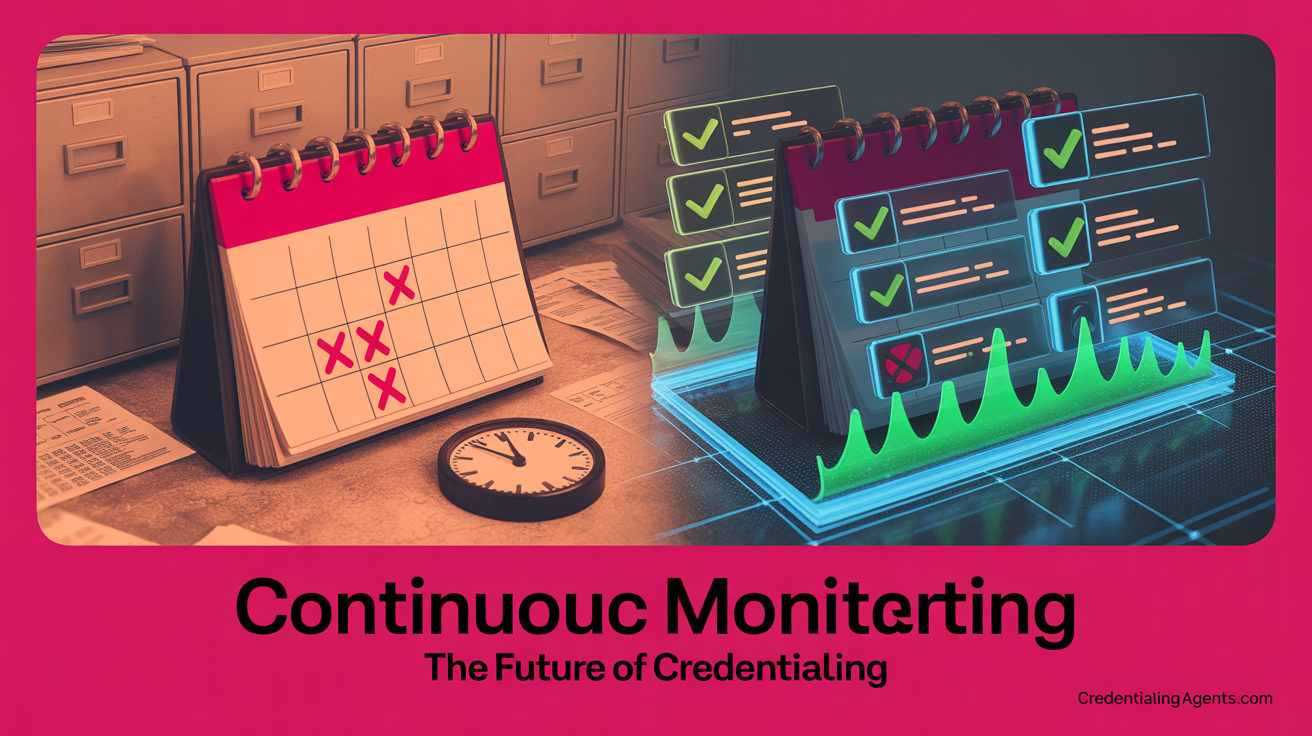
From Periodic to Continuous: Why Real-Time Credential Monitoring Is Replacing Annual Reviews
For decades, healthcare credentialing operated on a simple principle: verify once, trust for a year, repeat. Annual reviews. Quarterly spot-checks. The occasional re-credentialing cycle every 2-3 years.
That model is dying—and for good reason.
The Fatal Flaw of Periodic Credentialing
Consider this nightmare scenario: A nurse's license expires in February. Your agency's next credential review isn't until June. For four months, you're placing a clinician who technically isn't licensed to practice.
Or worse: A physician receives a sanction from the OIG in March. Your monthly exclusion check happens on the 1st. They work 29 days before you catch it—29 days of billing that CMS can claw back, plus penalties.
Periodic credentialing creates compliance gaps by design. Every day between checks is a day something could go wrong without you knowing.
The Rise of Continuous Monitoring
The industry is shifting toward real-time credential surveillance—systems that don't wait for scheduled reviews but instead monitor continuously for:
- License expirations and status changes - Instant alerts when state boards update records
- Sanctions and exclusions - Daily OIG/SAM database monitoring, not monthly
- Malpractice actions - Real-time NPDB query integration
- DEA registration changes - Automated controlled substance authorization tracking
- Board certification lapses - Proactive alerts before expiration, not after
The difference isn't just speed—it's paradigm shift from reactive compliance to proactive risk management.
Why Staffing Agencies Can't Afford to Wait
1. Regulatory Pressure Is Intensifying
The Joint Commission and CMS are tightening expectations around real-time verification. The days of annual re-credentialing as a compliance checkbox are numbered. Accreditation bodies increasingly expect continuous compliance, not periodic compliance.
2. Clients Are Demanding It
Hospital systems and health networks are asking harder questions during RFPs: "How often do you verify credentials?" Monthly isn't cutting it anymore. "Real-time" is becoming the expected answer.
3. The Cost of Catching Problems Late
A credential gap discovered at audit costs exponentially more than one caught in real-time:
| Discovery Timing | Typical Cost |
| Real-time (same day) | $0 - Minor admin time |
| Within 30 days | $500 - $2,000 in rework |
| At quarterly review | $5,000 - $15,000 in remediation |
| At annual audit | $25,000+ in penalties, lost contracts |
Continuous monitoring isn't an expense—it's insurance against catastrophic compliance failures.
What Continuous Monitoring Actually Looks Like
True continuous monitoring requires:
1. API integrations with primary sources - Direct connections to state licensing boards, DEA, NPDB, OIG, and certification bodies. Not screen scraping. Not manual lookups. Real-time data feeds.
2. Automated alert workflows - When a credential status changes, the right people get notified immediately. Not in an email digest tomorrow. Now.
3. Proactive expiration management - Alerts at 90, 60, 30, and 7 days before expiration. Automated reminders to clinicians. Escalation paths when renewals don't happen.
4. Audit-ready documentation - Every verification timestamped, every alert logged, every action recorded. When regulators ask "how did you know?", you have receipts.
The Technology Gap
Most credentialing software wasn't built for continuous monitoring. Legacy systems were designed around the periodic model—batch processing, scheduled reports, manual verification workflows.
Modern credentialing platforms are built different. AI-powered systems can monitor thousands of credentials simultaneously, flagging anomalies the moment they occur. Machine learning predicts which credentials are at risk of lapsing. Automation handles the routine verification work that used to require dedicated staff.
Making the Transition
Moving from periodic to continuous monitoring doesn't happen overnight. Here's a realistic roadmap:
Phase 1: Audit your current gaps - How often do you actually verify each credential type? Where are the longest gaps between checks?
Phase 2: Prioritize high-risk credentials - Start with licenses and sanctions. These carry the biggest compliance risk and have the most accessible real-time data sources.
Phase 3: Implement automated expiration tracking - Before you get to real-time verification, ensure you're never caught off-guard by an expiration.
Phase 4: Integrate primary source APIs - This is where technology investment matters. Partner with vendors who have direct integrations, not middleware solutions.
Phase 5: Build proactive workflows - Monitoring without action is just expensive observation. Create escalation paths that ensure issues get resolved, not just flagged.
The Competitive Advantage
Agencies that embrace continuous monitoring gain an edge that's hard to replicate:
- Faster placements - Pre-verified credentials mean faster client onboarding
- Lower risk - Catch issues before they become audit findings
- Better clinician experience - Proactive renewals reduce last-minute scrambles
- Stronger client relationships - Position yourself as the compliance-first partner
In a commoditized market, compliance excellence is a differentiator.
The Bottom Line
Periodic credentialing made sense when verifications required phone calls, faxes, and paper files. It was the best we could do with the tools available.
Those days are over.
Continuous monitoring isn't futuristic—it's here. Agencies that adapt will thrive. Those clinging to annual reviews will find themselves explaining gaps they should have caught months ago.
The question isn't whether to make the transition. It's whether you'll lead it or follow it.
Ready to move beyond periodic credentialing? Credentialing Agents uses AI-powered continuous monitoring to keep your credentials verified in real-time—so you're never caught between checks.