The Credentialing Bottleneck: Why Nearly Half of Travel Nurse Placements Fall Through
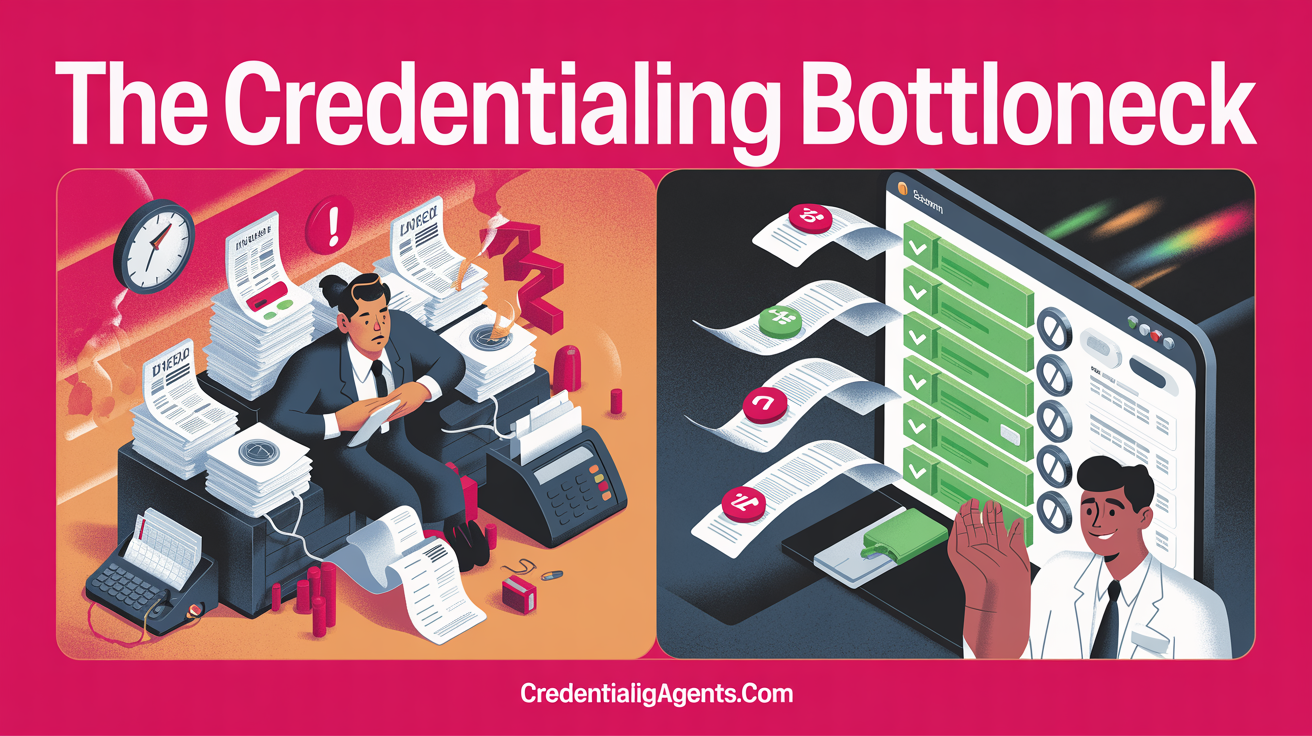
Every staffing agency knows the frustration: you have a qualified travel nurse, a facility ready to hire, and a contract waiting to be signed. Then credentialing stalls—and the placement evaporates.
Industry data suggests that up to 47% of travel nurse placements fail to close, with credentialing delays being the leading cause. That is not just a process problem. That is revenue walking out the door.
The Anatomy of a Credentialing Collapse
Credentialing a single travel nurse involves coordinating:
- Primary source verification of licenses across multiple states
- Background checks with varying turnaround times
- Skills checklists and competency validations
- Reference checks from previous employers
- Health screenings including immunization records and TB tests
- Facility-specific requirements that change from hospital to hospital
One missing document. One expired certification. One slow-responding reference. Any of these can push your placement past the start date—and into cancellation.
Why Manual Credentialing Cannot Keep Up
The average credentialing coordinator manages 75-100 active files at any given time. Each file requires:
- Tracking 30+ individual documents
- Following up on 5-10 outstanding items weekly
- Cross-referencing state-specific requirements
- Managing expiration date calendars
- Communicating with nurses, facilities, and third-party verifiers
When volume spikes—like during seasonal demand or crisis staffing events—the system breaks. Coordinators burn out. Files slip through cracks. Placements fail.
The Hidden Cost of Failed Placements
A single failed travel nurse placement costs more than the lost commission:
- Recruiter time wasted on a candidate who never starts
- Facility relationship damage when you cannot deliver promised staff
- Nurse frustration that leads to them working with competitors
- Credentialing team overtime trying to rush last-minute fixes
Multiply this across dozens of failed placements per quarter, and you are looking at hundreds of thousands in hidden costs.
How AI Changes the Credentialing Equation
Modern AI-powered credentialing platforms attack the bottleneck from multiple angles:
Automated Document Collection
Instead of chasing nurses for documents via email, AI systems send intelligent reminders, accept uploads via text, and auto-extract data from submitted files.
Real-Time Verification
Primary source verification that used to take days now happens in hours. AI agents query state boards, certification bodies, and verification databases simultaneously.
Predictive Expiration Management
Rather than discovering an expired BLS certification the week before a start date, AI systems flag upcoming expirations 90 days out and initiate renewal workflows automatically.
Facility Requirement Matching
Each hospital has unique requirements. AI systems maintain updated facility profiles and automatically identify gaps between a nurse credential file and a specific assignment.
The Competitive Advantage of Speed
In travel nursing, speed wins. The agency that can credential a nurse fastest gets the placement. When your competitors are running 14-day credentialing cycles and you are running 5-day cycles, you do not just close more placements—you close the best placements.
Moving From Bottleneck to Competitive Advantage
Credentialing does not have to be the weakest link in your staffing operation. With the right technology, it becomes your differentiator.
The agencies winning in 2026 are not hiring more coordinators. They are deploying AI agents that work 24/7, never miss a deadline, and turn credentialing from a cost center into a competitive weapon.
Ready to eliminate your credentialing bottleneck? Credentialing Agents deploys AI-powered credentialing automation purpose-built for healthcare staffing. See how leading agencies are cutting credentialing time by 70% while improving compliance.