The Credentialing Speed Gap: Why Every Day of Delay Costs You Placements
The Credentialing Speed Gap: Why Every Day of Delay Costs You Placements
In healthcare staffing, time kills deals. Every day a nurse sits in your credentialing queue is a day your competitors are placing them somewhere else.
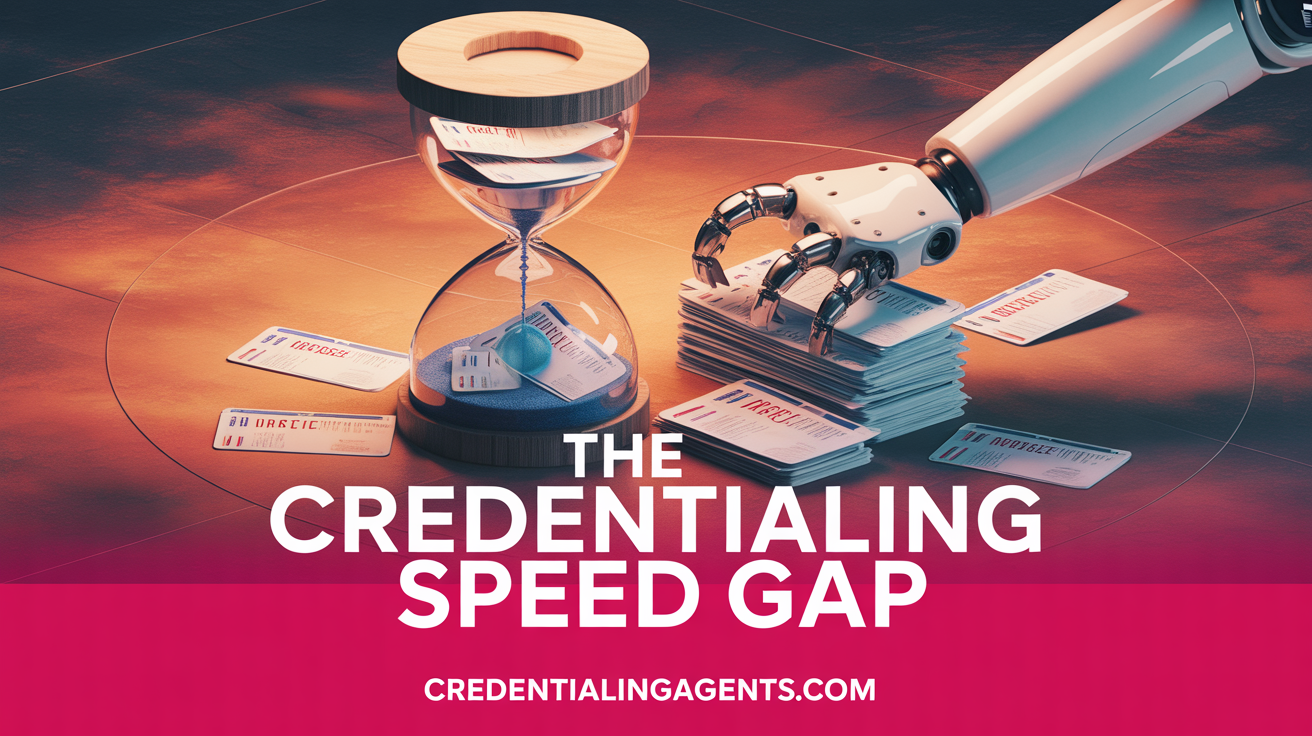
We call this the Credentialing Speed Gap—the difference between how fast facilities need nurses and how long it actually takes to get them credentialed and ready to work.
The Math Is Brutal
Let's break it down:
- Average time to credential a travel nurse manually: 21-45 days
- Time a facility can wait before going with another agency: 7-14 days
- Placements lost to credentialing delays: 30-40% of your pipeline
That's not a credentialing problem. That's a revenue problem.
Where the Time Actually Goes
When we audit credentialing workflows at staffing agencies, here's where we typically find the bottlenecks:
1. Primary Source Verification (PSV)
Average time: 5-15 days
Manually verifying licenses, certifications, and education through state boards and institutions is tedious. Each state has different systems, different response times, and different requirements.
2. Document Chase
Average time: 7-14 days
Nurses are busy working. Getting them to upload TB tests, immunization records, BLS cards, and competency checklists? It's like herding cats.
3. Compliance Review
Average time: 3-7 days
Someone has to actually review everything, flag discrepancies, and ensure the file is facility-ready. Most agencies have 1-2 people doing this for hundreds of nurses.
4. Facility-Specific Requirements
Average time: 3-10 days
Every hospital has its own checklist. Some want N95 fit test results. Others need specific EMR competencies. MSAs add another layer.
Total: 21-45 days—if nothing goes wrong. And something always goes wrong.
Why Traditional Solutions Don't Scale
Hiring more credentialing specialists? Expensive, and good ones are hard to find. Plus, there's a ceiling to how fast humans can manually verify documents.
Better software? Most credentialing platforms are just fancy checklists. They organize the chaos but don't actually speed up the process.
Outsourcing? Hit or miss. Quality varies wildly, and you lose control over the candidate experience.
The AI Credentialing Revolution
Here's what changes when you add AI agents to the credentialing workflow:
Automated PSV
AI agents can verify licenses across all 50 states simultaneously, checking directly against Nursys, state board databases, and NPDB. What took days now takes hours.
Intelligent Document Collection
Smart reminders, auto-extraction from uploaded documents, and AI that can read and validate credentials in real-time. Nurses upload once; the system does the rest.
Predictive Compliance
AI that knows facility requirements and proactively identifies gaps before they become blockers. No more last-minute scrambles for missing documents.
Continuous Monitoring
Expirations, license renewals, disciplinary actions—AI watches everything and alerts you before problems happen.
The New Credentialing Timeline
Agencies using AI-powered credentialing are seeing:
- PSV completion: 24-48 hours (down from 5-15 days)
- Document collection: 3-5 days (down from 7-14 days)
- Total time to credential: 5-10 days (down from 21-45 days)
That's not incremental improvement. That's a competitive advantage.
Close the Gap
The agencies winning right now aren't the biggest. They're the fastest. They're the ones placing nurses while competitors are still chasing immunization records.
The credentialing speed gap is real. The question is: which side of it are you on?
Ready to close your credentialing speed gap? Credentialing Agents uses AI to automate primary source verification, document collection, and compliance monitoring—so you can place nurses faster than ever.