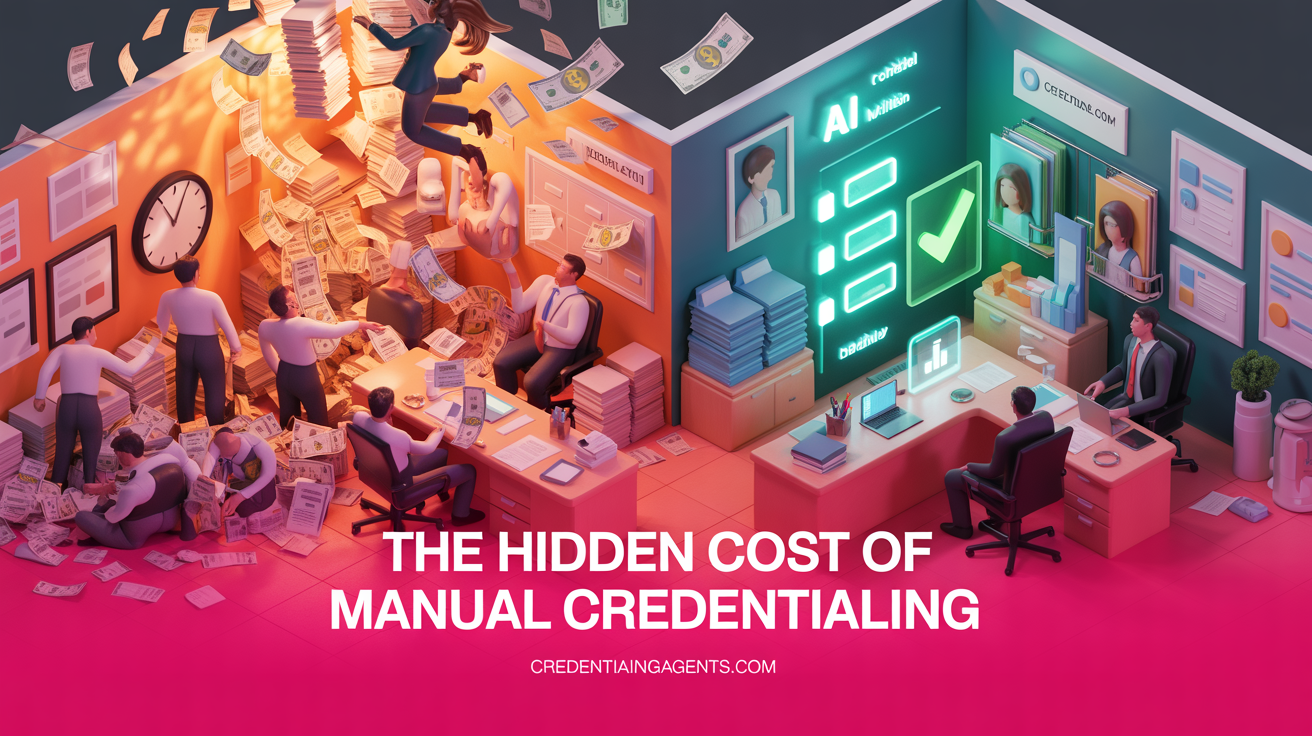
The Hidden Cost of Manual Credentialing: Why Healthcare Staffing Agencies Are Bleeding Money
In the high-stakes world of healthcare staffing, every minute counts. Yet thousands of agencies are hemorrhaging money through an invisible wound: manual credentialing processes.
The numbers are staggering. The average healthcare staffing agency spends 23 hours per candidate on credentialing verification alone. Multiply that by hundreds of nurses, and you are looking at a full-time team doing nothing but chasing documents, making verification calls, and updating spreadsheets.
But the real cost is not just labor. It is opportunity.
The True Price of Slow Credentialing
When a travel nurse is ready to work but stuck in credentialing limbo, everyone loses:
- The nurse misses shifts and income
- The facility remains understaffed
- Your agency loses the placement fee
- Your competitor fills the role instead
Industry data shows that agencies with credentialing times exceeding 14 days lose up to 30% of potential placements to faster competitors. In a $50 billion market, that is not a rounding error—it is an existential threat.
Where the Money Actually Goes
Let us break down the hidden costs most agencies never calculate:
1. Labor Costs
Credentialing specialists earn $45,000-$65,000 annually. Most agencies need 1 specialist per 75-100 active travelers. As you scale, this ratio creates a staffing cliff.
2. Error and Rework
Manual data entry has a 1-4% error rate. Each error triggers rework, delays, and potential compliance violations. The Joint Commission does not grade on a curve.
3. Expiration Tracking
Licenses expire. Certifications lapse. BLS cards need renewal. Manual tracking systems inevitably miss deadlines, leading to emergency scrambles or—worse—compliance gaps that put facilities at risk.
4. Opportunity Cost
Every hour your team spends on administrative credentialing is an hour not spent on relationship building, recruiting, or strategic growth.
The AI Credentialing Revolution
Here is what modern AI-powered credentialing looks like:
- Primary source verification completed in hours, not weeks
- Automated document collection that chases nurses so your team does not have to
- Real-time compliance monitoring that flags expirations before they become problems
- Instant facility-specific checklist generation that eliminates guesswork
Agencies using AI credentialing report 60-80% reductions in time-to-clear and 40% lower credentialing costs.
The Competitive Advantage Window
Right now, AI credentialing adoption is still in early innings. The agencies implementing these systems today are building sustainable competitive advantages:
- Faster placements mean happier nurses and facilities
- Lower overhead means better margins or more competitive rates
- Consistent compliance means lower risk and better facility relationships
But this window will not stay open forever. As AI credentialing becomes table stakes, early adopters will have already locked in market share.
Making the Shift
The transition from manual to AI-powered credentialing does not have to be painful. The key is finding a solution built specifically for healthcare staffing—not generic document management software with a healthcare skin.
Look for platforms that understand:
- State-specific license verification requirements
- Facility-specific credentialing packets
- The unique workflows of travel nursing compliance
- Integration with your existing ATS and VMS systems
Stop the Bleeding
Manual credentialing is not just inefficient—it is actively costing you placements, margin, and market position. The agencies that thrive in the next decade will be those that automated their credentialing today.
Ready to see how AI can transform your credentialing operations?
Discover how Credentialing Agents can cut your time-to-clear by 60% →
Credentialing Agents provides AI-powered credentialing automation purpose-built for healthcare staffing agencies. Our platform handles primary source verification, document collection, compliance monitoring, and facility-specific requirements—so your team can focus on what matters: placing nurses and growing your business.