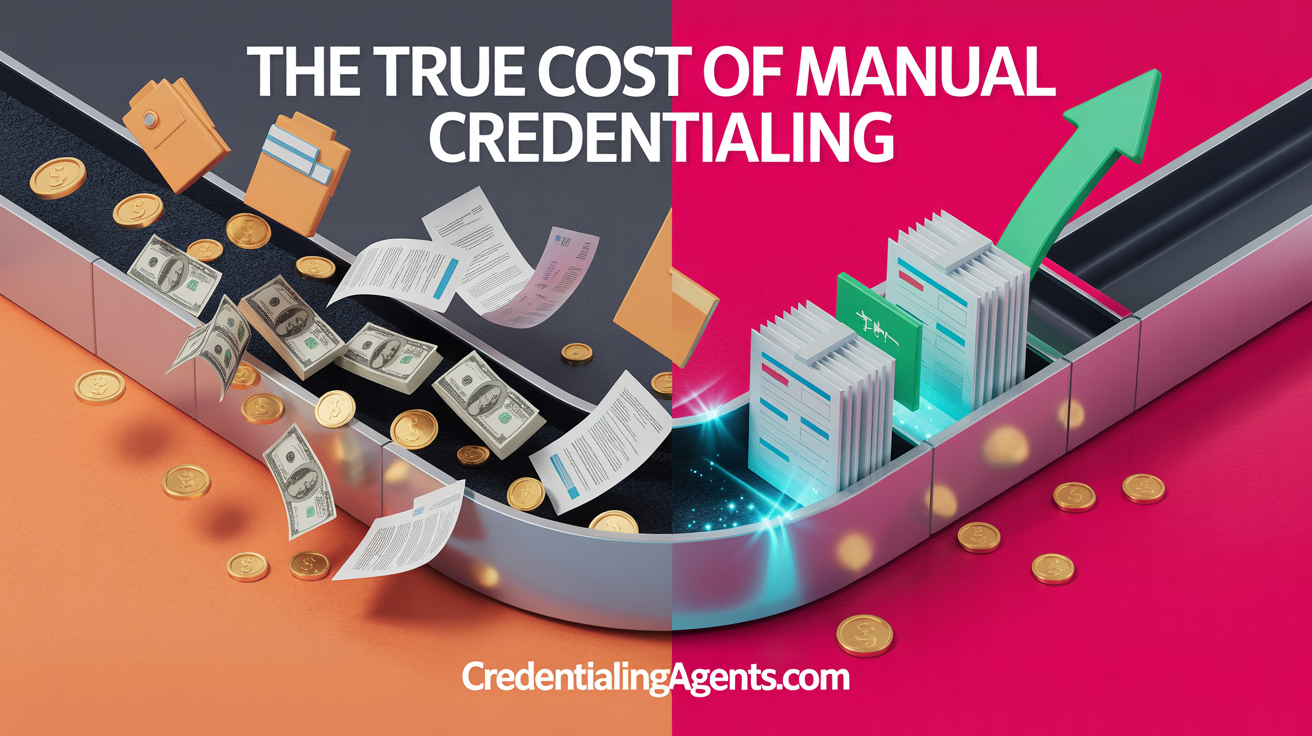
The Hidden Cost of Manual Credentialing: Why Healthcare Staffing Agencies Are Bleeding Money
Calculate the true cost of paper-based credentialing and discover how AI automation can recover lost revenue

Every healthcare staffing agency knows credentialing is a necessary evil. But few realize just how much money is slipping through their fingers every single day.
Let's do some uncomfortable math together.
The True Cost Nobody Talks About
The average healthcare staffing agency spends 40-60 hours per week on credentialing tasks. That's one full-time employee doing nothing but:
- Chasing down expired licenses
- Manually verifying certifications
- Playing phone tag with state boards
- Re-entering the same data into multiple systems
- Filing paperwork that will need to be refiled in 6 months
At an average credentialing specialist salary of $55,000/year (plus benefits, office space, and management overhead), you're looking at $75,000-$90,000 annually just to keep the credentialing machine running.
But that's just the visible cost.
The Hidden Hemorrhage
Delayed Placements = Lost Revenue
Every day a qualified nurse sits waiting for credentialing clearance is a day of lost billable hours. If your average placement bills at $85/hour and credentialing delays cost you just 3 days per placement:
3 days × 8 hours × $85 = $2,040 per placement
With 50 placements per month? That's $102,000 in delayed revenue annually—and that's conservative.
Compliance Failures Are Expensive
A single credentialing lapse can result in:
- CMS penalties ranging from $10,000-$50,000
- Loss of facility contracts worth millions
- Malpractice exposure that insurance won't cover
- Reputation damage that takes years to repair
The Joint Commission found that 23% of sentinel events had credentialing-related contributing factors. One mistake can unravel years of relationship building.
Staff Burnout Is Real
Credentialing specialists have one of the highest turnover rates in healthcare staffing. The repetitive, high-stakes nature of the work leads to:
- Average tenure of just 18 months
- Recruiting costs of $4,000-$6,000 per replacement
- 3-6 month ramp-up time for new hires
- Institutional knowledge walking out the door
Why "Good Enough" Isn't
Most agencies have tried to solve this with:
Spreadsheets - Works until it doesn't. One missed expiration date, one formula error, one employee who forgets to update the master file.
Basic CVM Software - Better, but still requires manual data entry, manual verification, manual follow-ups. You've automated the filing cabinet, not the work.
Hiring More Staff - Throwing bodies at the problem just multiplies your costs without solving the underlying inefficiency.
The AI Credentialing Revolution
Here's what modern AI-powered credentialing actually looks like:
Primary Source Verification in Minutes, Not Days
AI agents can simultaneously query state licensing boards, the NPDB, OIG exclusion lists, and certification bodies—completing verifications that would take a human 4-6 hours in under 10 minutes.
Predictive Expiration Management
Instead of scrambling when licenses expire, AI tracks every credential across your entire workforce and initiates renewal workflows 90 days in advance. No more emergency renewals. No more lapsed credentials.
Automated Document Collection
AI-powered systems can send personalized reminders to healthcare workers, accept document uploads 24/7, use OCR to extract and verify data, and flag discrepancies before they become problems.
Continuous Compliance Monitoring
Real-time scanning for sanctions, exclusions, license actions, and adverse events. Know about problems when they happen, not when Joint Commission shows up.
The ROI Math That Actually Matters
Let's revisit those numbers with AI credentialing:
| Cost Category | Manual Process | AI-Powered | Annual Savings |
| Staff costs | $75,000 | $15,000 | $60,000 |
| Delayed placements | $102,000 | $25,500 | $76,500 |
| Compliance risk | $50,000+ | ~$5,000 | $45,000+ |
| Turnover costs | $12,000 | $2,000 | $10,000 |
| Total | $239,000+ | $47,500 | $191,500+ |
That's not a typo. 80% cost reduction is achievable with the right AI credentialing solution.
What to Look for in AI Credentialing
Not all "AI" credentialing tools are created equal. Here's your checklist:
✅ True automation - Not just reminders, but actual verification and document processing
✅ Healthcare-specific training - Generic AI doesn't understand the difference between an RN compact license and a single-state license
✅ Integration capabilities - Must connect with your ATS, VMS, and existing workflows
✅ Audit trail - Every action logged, timestamped, and defensible
✅ Human oversight - AI handles the routine; humans handle the exceptions
Stop the Bleeding
Every week you spend on manual credentialing is another week of:
- Money walking out the door
- Compliance risks accumulating
- Good employees burning out
- Competitors gaining ground
The technology exists today to transform credentialing from a cost center into a competitive advantage. The only question is whether you'll adopt it before your competitors do.
Ready to see what AI-powered credentialing can do for your agency?
Visit CredentialingAgents.com to learn how healthcare staffing agencies are cutting credentialing costs by 80% while improving compliance rates.
Your credentials. Our AI agents. Zero headaches.