The Hidden Cost of Manual Primary Source Verification: Why Healthcare Staffing Agencies Are Bleeding Time and Money
Every healthcare staffing agency knows the drill. A new nurse applies, and the credentialing clock starts ticking. License verification. DEA checks. Background screenings. Education confirmation. The list goes on—and so does the manual labor.
But here's what most agencies don't calculate: the true cost of doing it the old way.
The Math Nobody Wants to Do
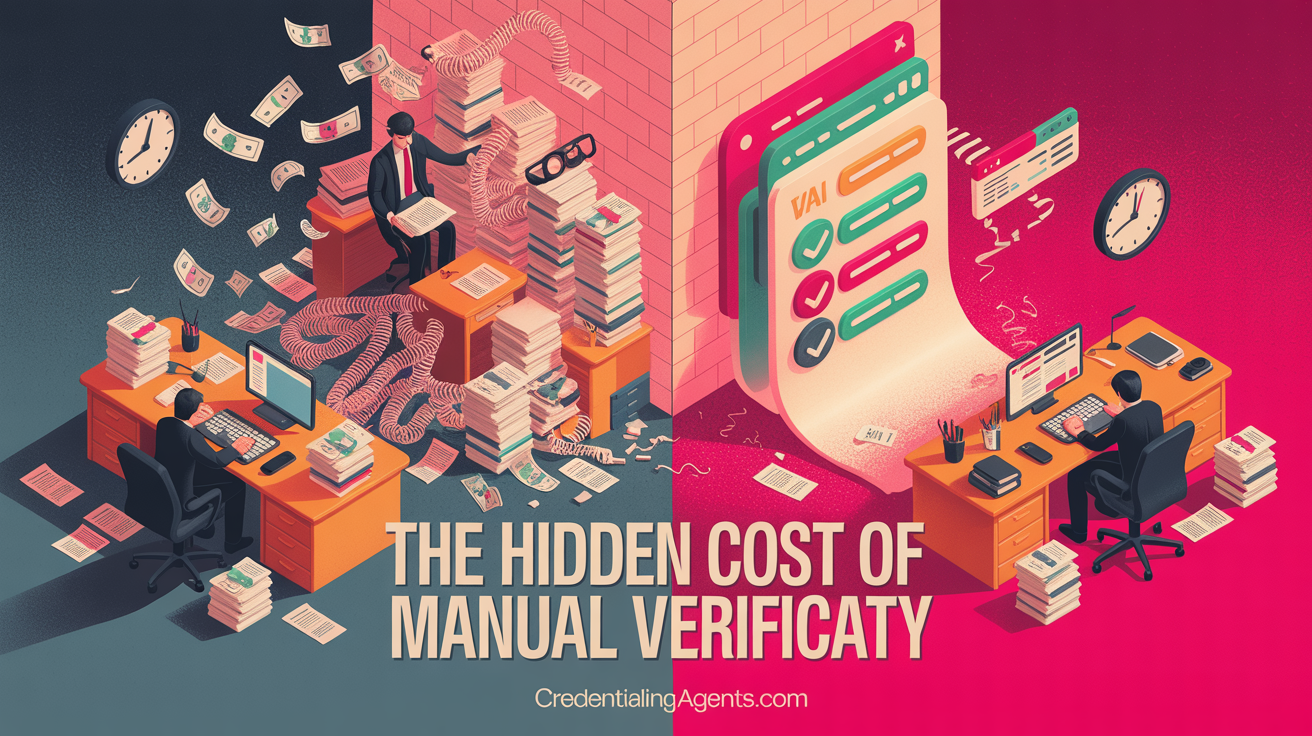
Let's break it down. The average healthcare credential specialist earns $22-28 per hour. Each primary source verification (PSV) takes 15-45 minutes when done manually—assuming you get through on the first call. Multiply that across:
- State nursing board verifications
- NPDB queries
- OIG/SAM exclusion checks
- Education and certification confirmations
- Employment history verification
- Reference checks
A single travel nurse placement can require 20+ individual verifications. At an average of 25 minutes per check, that's over 8 hours of credentialing labor per candidate—just for initial onboarding.
The Hidden Multipliers
But wait. The clock doesn't stop there.
Hold times. State boards aren't exactly known for speedy phone service. One verification can eat 45 minutes when you factor in hold music and transfers.
Failed attempts. Offices close. Systems go down. Fax machines jam. Each retry compounds the time investment.
Re-credentialing. Most credentials expire annually. That 8-hour investment? It's recurring. Forever.
Compliance documentation. Every verification needs logging, filing, and audit preparation. Paper trails create paper mountains.
What This Really Costs
Here's a conservative estimate for a mid-size staffing agency placing 50 travel nurses per month:
| Cost Category | Monthly Impact |
| Direct labor (credentialing staff) | $12,000-18,000 |
| Opportunity cost (delayed placements) | $25,000-50,000 |
| Compliance risk exposure | Incalculable |
| Staff burnout and turnover | $5,000-10,000 |
That's potentially $90,000+ per month lost to inefficiency—not including the placements you couldn't make because credentialing bottlenecked your pipeline.
The Velocity Problem
In healthcare staffing, speed wins contracts. Hospitals don't wait. When a unit needs coverage, they're calling every agency in their vendor management system simultaneously.
The agency that delivers a fully credentialed, compliant nurse first gets the placement. Period.
Manual verification creates a ceiling on your velocity. You can only hire so many credentialing specialists. They can only make so many calls. The math doesn't scale.
The AI Credentialing Shift
This is why forward-thinking agencies are automating primary source verification entirely.
Modern AI credentialing agents can:
- Run parallel verifications across all required sources simultaneously
- Navigate state board portals programmatically, eliminating hold times
- Maintain real-time compliance monitoring with automatic re-verification triggers
- Generate audit-ready documentation instantly
- Scale infinitely without adding headcount
What takes a human 8+ hours takes AI minutes. Not because AI is "smarter"—but because it doesn't wait on hold.
The Competitive Reality
Here's the uncomfortable truth: your competitors are already automating this.
Agencies using AI credentialing are placing nurses while you're still verifying licenses. They're capturing market share while you're paying people to listen to hold music.
The cost of manual verification isn't just what you're spending—it's what you're losing.
Making the Shift
Automating credentialing doesn't mean eliminating your compliance team. It means unleashing them. When AI handles the repetitive verification grind, your credentialing specialists can focus on complex cases, candidate relationships, and strategic compliance initiatives.
The agencies winning in 2026 aren't the ones with the biggest credentialing departments. They're the ones who've automated the grunt work and redirected that human intelligence to higher-value activities.
Ready to stop bleeding time and money on manual verification?
Credentialing Agents is purpose-built AI for healthcare staffing credentialing. We handle primary source verification, compliance monitoring, and audit documentation—so your team can focus on placing nurses, not chasing paperwork.