One License, 43 States: How the Nurse Licensure Compact Is Revolutionizing Healthcare Staffing
One License, 43 States: How the Nurse Licensure Compact Is Revolutionizing Healthcare Staffing
Imagine a world where your nursing license works like your driver's license—valid across state lines without paperwork, without delays, without the bureaucratic nightmare that has plagued healthcare staffing for decades.
That world is here. And if your staffing agency isn't leveraging it, you're leaving money on the table.
The Nurse Licensure Compact: A Game-Changer You Can't Ignore
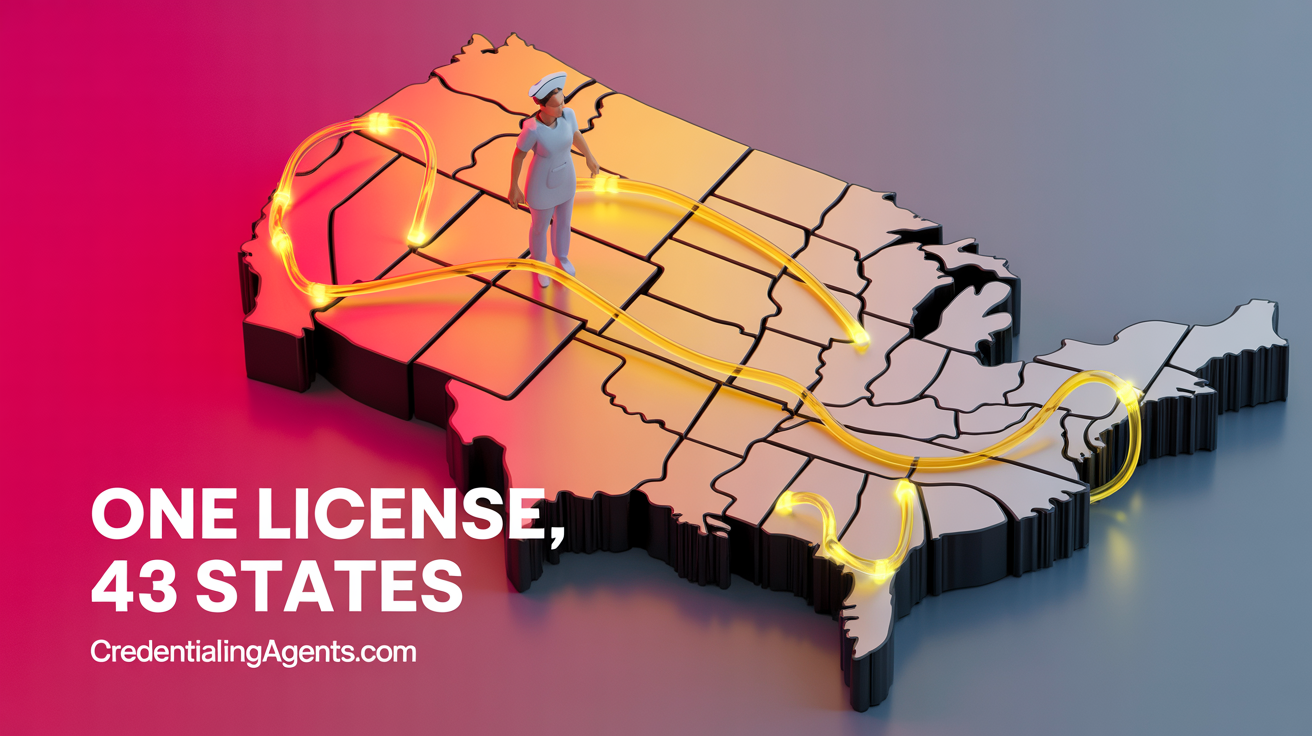
The Nurse Licensure Compact (NLC) now includes 43 states and territories, covering roughly 80% of the U.S. population. For nurses with a multistate license from a compact state, this means the freedom to practice in any member state without obtaining additional licenses.
For healthcare staffing agencies, this represents a seismic shift in how credentialing should work.
The Math That Should Keep You Up at Night
Consider the traditional licensing model:
- Average time to obtain a new state license: 4-12 weeks
- Cost per additional state license: $150-$400
- Revenue lost per day a nurse waits for licensure: $400-$800
Now multiply that across your entire travel nursing roster. If you're managing 100 nurses who each need 2-3 additional state licenses annually, you're looking at:
- $30,000-$120,000 in licensing fees alone
- Thousands of billable days lost to licensing delays
- Countless placement opportunities missed to faster competitors
With the NLC, a nurse can accept an assignment in a new compact state today and start working tomorrow.
Why Most Agencies Still Get This Wrong
Here's the problem: the NLC doesn't eliminate credentialing—it transforms it.
You still need to verify:
- Primary source verification of the multistate license
- State-specific requirements beyond licensure (facility privileging, certifications)
- Background checks and sanctions monitoring
- Skills assessments and competency validations
The agencies winning in this new landscape aren't just aware of the NLC—they've rebuilt their entire credentialing infrastructure around it. They can instantly identify which nurses hold multistate licenses, match them to compact-state opportunities, and complete the remaining credentialing requirements in hours, not weeks.
The Staffing Firms That Get It
Leading healthcare staffing organizations have recognized that compact licensure changes the competitive equation entirely. As industry leaders have noted, the agencies that can deploy nurses fastest will capture the lion's share of urgent staffing requests—and the premium rates that come with them.
The traditional model of credentialing nurses for specific states is becoming obsolete. Forward-thinking agencies are now credentialing for mobility—ensuring their nurses can accept opportunities wherever demand spikes.
What This Means for Your Agency
If you're still processing state-by-state licenses manually, you're operating with a fundamental disadvantage. Every day your competitor can place a nurse in Arizona while you're still waiting for paperwork is a day they're building relationships with facilities you'll never win back.
The new credentialing imperative:
- Identify compact license holders in your roster immediately
- Pre-credential for facility requirements in high-demand markets
- Automate license verification to confirm multistate validity in real-time
- Build state-specific checklists for non-licensure requirements
- Track compact expansion as new states join (Maine and New Hampshire are recent additions)
The States Still Outside the Compact
Seven states remain non-compact: California, New York, Massachusetts, Michigan, Illinois, Minnesota, and Washington. These represent some of the largest healthcare markets in the country—and the most credentialing-intensive.
For these states, the traditional licensing grind continues. But here's the strategic insight: agencies that master compact-state credentialing can redirect resources toward conquering these holdout markets, creating a two-track system that maximizes nurse deployment everywhere.
The AI Advantage
Manual credentialing processes can't keep pace with the NLC opportunity. When a facility in Texas posts an urgent need at 2 PM, the agency that can verify a Florida nurse's multistate license, confirm her BLS certification, check OIG sanctions, and submit her credentials by 3 PM wins the placement.
That's not a human workflow—that's an AI-powered credentialing engine.
At Credentialing Agents, we've built exactly this. Our AI-powered platform:
- Instantly verifies multistate license status through Nursys and state boards
- Maintains real-time credential passports for every nurse
- Identifies facility-specific requirements beyond licensure
- Automates the entire submission process
The Bottom Line
The Nurse Licensure Compact has rewritten the rules of healthcare staffing. The winners in this new era won't be the agencies with the most recruiters—they'll be the agencies with the fastest, most intelligent credentialing operations.
Your nurses are ready to work across 43 states. Is your credentialing process ready to let them?
Ready to transform your credentialing operation for the compact era? Schedule a demo with Credentialing Agents and see how AI-powered automation can turn the NLC from an opportunity into your competitive advantage.