The 72-Hour Credentialing Crisis: Why Healthcare Staffing Delays Cost You $47,000 Per Week
How AI-powered credentialing is eliminating the bottleneck that keeps qualified nurses off the floor
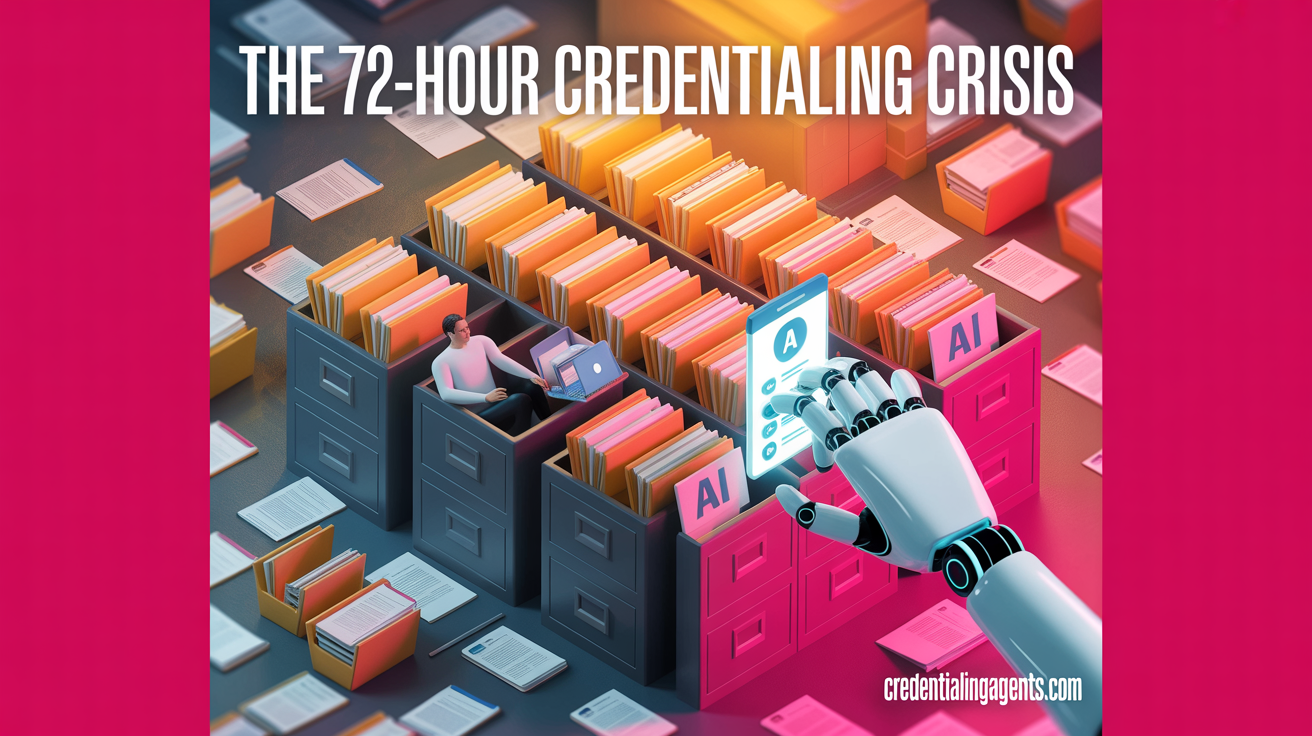
Every day a travel nurse waits for credentialing is a day your facility runs short-staffed. And according to recent industry data, the average healthcare credentialing process takes 21 days—with some stretching to 60 days or more.
That is not just an administrative inconvenience. It is a $47,000 weekly cost per unfilled position when you factor in overtime, agency premiums, and patient care impacts.
Welcome to the 72-hour credentialing crisis.
The Hidden Math of Credentialing Delays
Let us break down what happens when credentialing stalls:
- Week 1-2: Primary source verification requests sit in queues at state boards and previous employers
- Week 2-3: Missing documents trigger back-and-forth emails that nobody tracks properly
- Week 3-4: Manual data entry errors require re-verification
- Week 4+: Your qualified candidate accepts another offer
Meanwhile, your facility pays premium rates for coverage, burns out existing staff, and watches patient satisfaction scores decline.
Why Traditional Credentialing Breaks Down
The credentialing process was designed for a different era—one where nurses stayed at single facilities for decades and paperwork moved through physical mail.
Today is reality:
- Travel nursing has grown 40% since 2020
- Nurses work across multiple states with different requirements
- Compact licenses create verification complexity
- State boards are understaffed and overwhelmed
Your credentialing team is fighting 2026 problems with 1996 processes.
The 72-Hour Standard: What AI Makes Possible
Modern AI-powered credentialing platforms are rewriting the rules. Here is what best-in-class now looks like:
Automated Primary Source Verification
Instead of waiting weeks for manual verification requests, AI agents connect directly to state board databases, NPDB, and education verification systems—returning verified results in hours, not weeks.
Intelligent Document Processing
AI reads, extracts, and validates credentials from any document format. No more manual data entry. No more transcription errors. No more chasing missing fields.
Proactive Expiration Management
The system tracks every license, certification, and immunization record—automatically alerting staff and initiating renewals before gaps occur.
Multi-State Compliance Engine
When a nurse needs to work in Texas, California, and Florida, AI maps their existing credentials against each state's requirements and identifies exactly what is needed.
Real Results from AI Credentialing
Healthcare organizations implementing AI credentialing are seeing:
- 73% reduction in time-to-credential
- 89% decrease in verification errors
- $2.1M annual savings in administrative costs (for mid-size staffing agencies)
- 94% candidate satisfaction scores
The math is simple: faster credentialing means more placements, less overtime, and better patient care.
What to Look for in an AI Credentialing Solution
Not all automation is created equal. Here is what separates real AI credentialing from glorified document management:
- True primary source integration - Direct API connections to verification sources, not just email automation
- Intelligent exception handling - AI that escalates complex cases appropriately, not blindly
- Compliance-first architecture - Built for healthcare regulatory requirements from day one
- Staffing workflow integration - Works with your existing ATS and VMS systems
The Credentialing Agents Difference
At Credentialing Agents, we have built AI that thinks like your best credentialing specialist—but works 24/7 without coffee breaks.
Our platform handles:
- License verification across all 50 states
- Certification tracking (BLS, ACLS, specialty certs)
- Education and employment verification
- Exclusion screening (OIG, SAM, state exclusion lists)
- Immunization and health requirement compliance
All while integrating seamlessly with your existing staffing technology stack.
Stop Losing Candidates to Credentialing Delays
Every week you spend on manual credentialing is a week your competitors are placing nurses.
The 72-hour credentialing standard is not a fantasy—it is what AI makes possible today.
Ready to see how fast credentialing can be?
Book a demo at CredentialingAgents.com and discover how AI can transform your credentialing operations.
Credentialing Agents is an AI-powered credentialing automation platform built specifically for healthcare staffing. We help agencies and facilities reduce time-to-credential by 73% while eliminating verification errors.