The 72-Hour Credentialing Promise: How AI is Turning Weeks into Days for Healthcare Staffing
Manual credentialing is costing staffing agencies revenue and talent. Here's how leading agencies are cutting turnaround from 3 weeks to 72 hours.
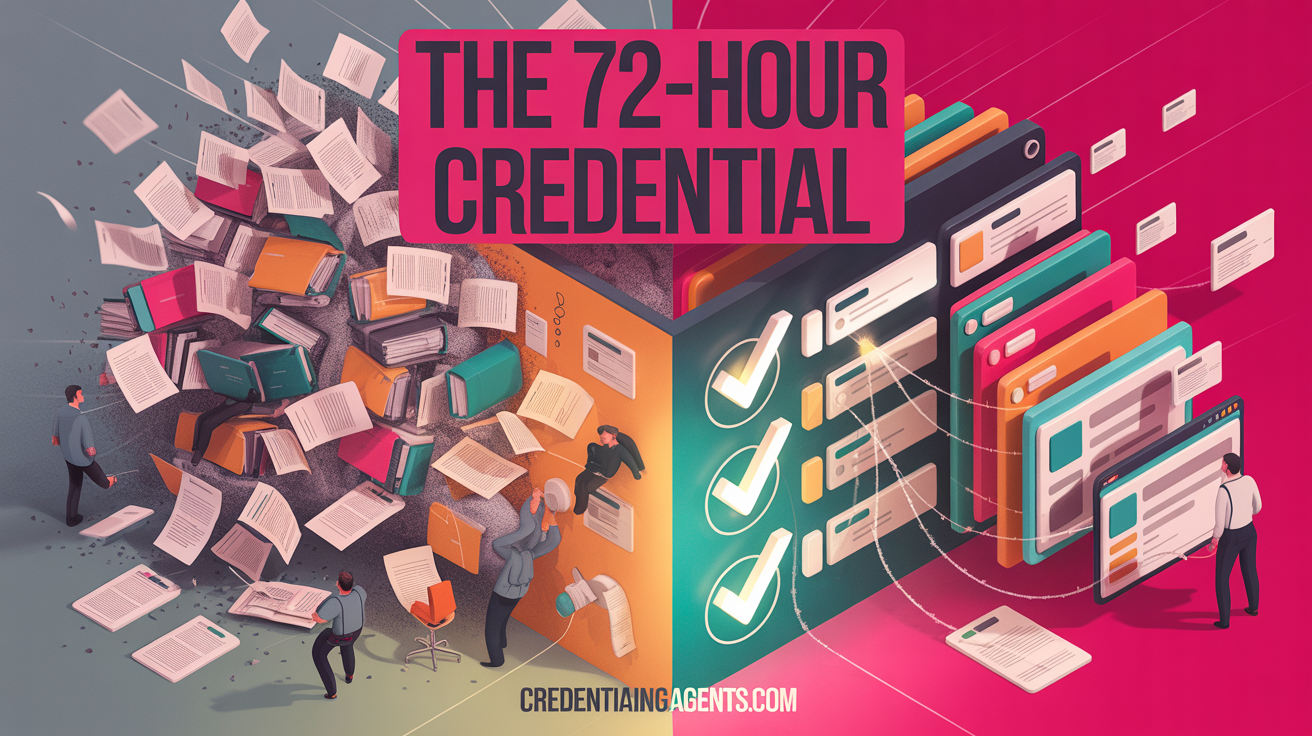
In healthcare staffing, time kills deals.
Every day a nurse waits for credentialing approval is a day they're not billing. Every week of backlog is a placement lost to a competitor. And every manual verification bottleneck compounds into a staffing crisis that costs agencies millions.
The industry average for credentialing a single healthcare professional? 21 days.
That's three weeks of:
- Primary source verification phone tag
- Chasing expired licenses across state boards
- Cross-referencing exclusion databases manually
- Waiting on education transcripts
- Following up on employment verifications
For travel nurses ready to start assignments, that wait feels like an eternity. For staffing agencies, it's revenue sitting in purgatory.
The Hidden Math of Slow Credentialing
Let's run the numbers on a mid-size healthcare staffing agency:
- 500 active candidates in the credentialing pipeline
- 21-day average turnaround per candidate
- $1,500/week billing rate per placed nurse (agency margin)
- 15% candidate drop-off due to slow processing
That 15% attrition alone represents $5.85 million in annual lost revenue. And that's before counting the overtime your credentialing team burns trying to keep up.
Why Manual Credentialing Can't Scale
The problem isn't your credentialing specialists—they're doing heroic work. The problem is the process itself:
Primary Source Verification (PSV) requires contacting each issuing institution directly. Phone calls. Faxes. Yes, faxes still.
State License Verification means navigating 50+ different board websites, each with their own login, format, and update schedule.
OIG/SAM Exclusion Checks must happen monthly—not just at onboarding—creating perpetual workload.
Document Expiration Tracking across certifications (BLS, ACLS, specialty certs) multiplies exponentially with headcount.
One credentialing coordinator can typically manage 50-75 active files. When your candidate pipeline grows, you hire more coordinators. When it shrinks, you're overstaffed. There's no elasticity.
The 72-Hour Standard: What AI-Powered Credentialing Looks Like
Leading healthcare staffing agencies are achieving something that seemed impossible two years ago: complete credentialing in 72 hours or less.
Here's how:
Automated Primary Source Verification
AI agents connect directly to licensing boards, educational institutions, and verification databases—24/7. No phone tag. No business hours limitations. No human bottleneck.
Intelligent Document Processing
Upload a nursing license, and AI extracts the license number, expiration date, state, and compact status in seconds. It cross-references against the source automatically.
Continuous Compliance Monitoring
Instead of monthly manual OIG checks, AI monitors exclusion databases continuously. Any hit triggers an immediate alert—not a report that sits in someone's inbox.
Predictive Expiration Management
AI tracks every credential expiration across your entire workforce and initiates renewal workflows automatically—60, 30, and 7 days before expiration.
The Competitive Advantage of Speed
In a market where nurses have options, the agency that credentials fastest often wins the placement.
Think about it from the nurse's perspective:
- Agency A says: "We'll have you cleared in 2-3 weeks."
- Agency B says: "You'll be assignment-ready by Friday."
Which call does the nurse take next Monday?
Speed isn't just operational efficiency—it's a recruiting and retention advantage. The agencies winning the talent war aren't just paying better rates; they're respecting their nurses' time.
Making the Shift: What It Takes
Transitioning from manual to AI-powered credentialing isn't a flip-the-switch operation. It requires:
- Process audit: Map every verification step, data source, and handoff point
- Integration planning: Connect your ATS, HRIS, and compliance systems
- Change management: Retrain coordinators as exception handlers, not data processors
- Phased rollout: Start with new hires, then backfill active roster
The good news? Modern credentialing platforms are designed for this transition. They augment your team rather than replace it—handling the 80% of routine verifications so your specialists can focus on complex cases.
The Bottom Line
Healthcare staffing is a speed game. The agencies still running 21-day credentialing cycles aren't just inefficient—they're leaving millions on the table and losing top talent to faster competitors.
72 hours isn't aspirational anymore. It's the new standard.
Ready to see how AI-powered credentialing can transform your staffing operations? Credentialing Agents helps healthcare staffing agencies cut credentialing time by 80% while maintaining bulletproof compliance. Book a demo to see the 72-hour promise in action.