The 72-Hour Rule: Why Speed Determines Survival in Healthcare Staffing
How the fastest credentialing teams are winning the battle for top nursing talent
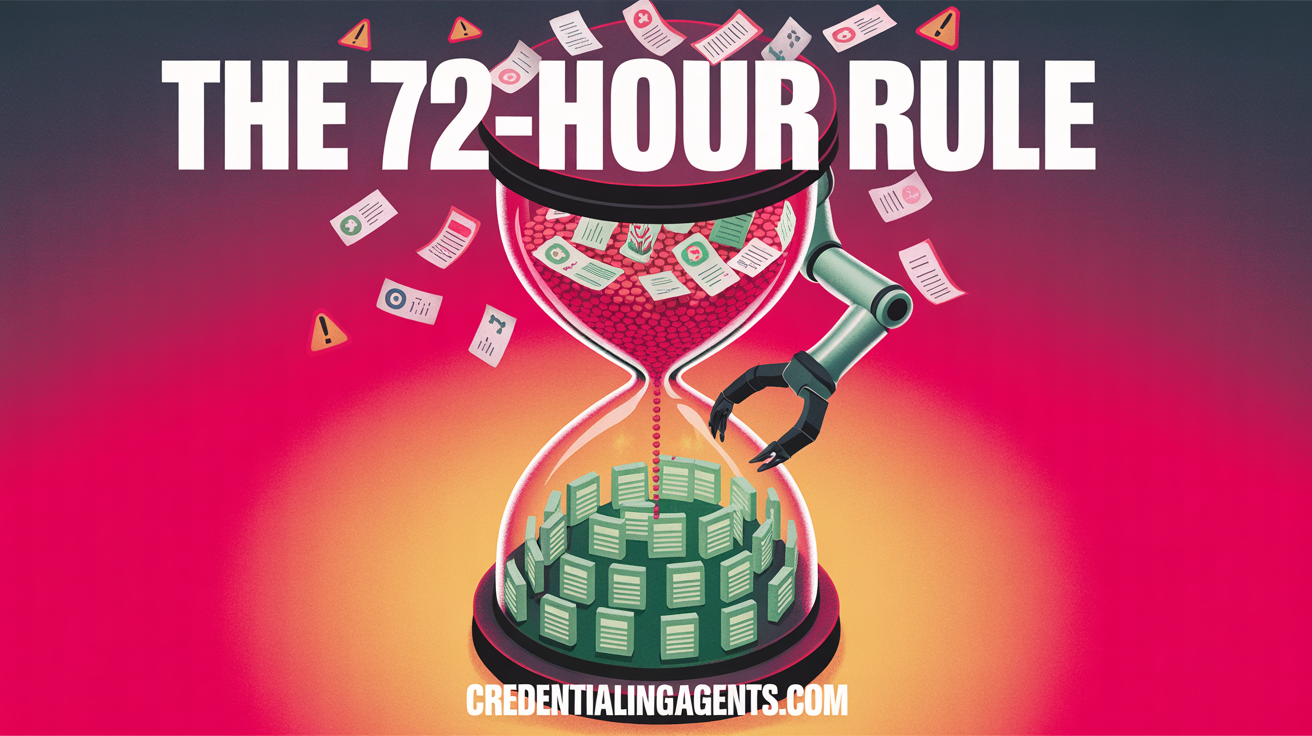
In healthcare staffing, there's an unwritten rule that separates agencies that thrive from those that struggle: the 72-hour window.
When a travel nurse applies, you have roughly 72 hours to get them credentialed, submitted, and in front of the client—or you've lost them to a competitor who moved faster.
This isn't speculation. It's the brutal math of a market where demand outstrips supply and top candidates have options.
The Credentialing Bottleneck Nobody Talks About
Most staffing agencies know they have a speed problem. What they don't realize is where the slowdown actually happens.
It's not recruiting. Sourcing qualified nurses has never been faster with job boards and social recruiting.
It's not sales. Most agencies have MSP relationships and VMS access ready to submit candidates.
It's credentialing. The black hole where applications go to die.
Consider what happens when a nurse applies:
- Primary source verification of licenses (2-5 business days)
- Background check processing (1-3 business days)
- Skills checklist verification (requires manual follow-up)
- Reference checks (dependent on former employers responding)
- Immunization record validation (often incomplete, requires tracking down records)
- Competency testing (scheduling delays)
- I-9 and compliance documentation (manual review)
Each step introduces friction. Each handoff creates delay. And while your compliance team is manually chasing documents, your competitor with a streamlined process has already submitted that nurse.
What the Math Actually Looks Like
Let's say your agency receives 100 nurse applications per month.
Traditional credentialing timeline: 14-21 days average
- 40% of candidates accept other offers before completion
- 15% abandon the process due to frustration
- You're left submitting maybe 45 candidates
Accelerated credentialing timeline: 48-72 hours
- 10% accept other offers (the fastest movers)
- 5% abandon (minimal friction = minimal dropout)
- You're submitting 85 candidates from the same applicant pool
That's not a marginal improvement. That's nearly doubling your submission rate from the same recruiting spend.
Why Manual Credentialing Can't Scale
Here's the uncomfortable truth: you cannot hire your way out of this problem.
Credentialing coordinators are expensive, hard to find, and prone to burnout. The work is repetitive—checking boxes, sending follow-up emails, logging into verification portals, copying data between systems.
When volume spikes (and in healthcare staffing, it always spikes), your team becomes overwhelmed. Quality drops. Things slip through cracks. Nurses get frustrated waiting.
And here's the kicker: even a fully-staffed credentialing team can't beat the physics of manual verification. If the state nursing board takes 3 days to respond, it takes 3 days. If the background check vendor batches requests, you're waiting.
The AI-Powered Alternative
This is where intelligent automation changes the game.
AI credentialing systems don't just digitize the process—they parallelize it. Instead of sequential steps where each one waits for the previous to complete, intelligent systems:
- Initiate all verifications simultaneously at the moment of application
- Pre-populate data from existing records (no redundant data entry for returning nurses)
- Automatically follow up on pending items without human intervention
- Flag exceptions for human review while routine checks auto-complete
- Maintain compliance documentation automatically
The result? What took 2-3 weeks now takes 24-72 hours. Not through cutting corners—through eliminating the wasted time between steps.
Real Compliance, Real Speed
Some compliance officers hear "AI" and "fast" and immediately worry about risk. Fair concern—healthcare credentialing exists because lives depend on qualified professionals.
But speed and compliance aren't opposites. In fact, automated systems often improve compliance because:
- Every verification is logged with timestamps and audit trails
- Expiring credentials trigger automatic renewal workflows
- Nothing slips through because "we got busy"
- Consistency beats the best-intentioned manual process
The agencies getting dinged on audits aren't the ones moving fast with good systems. They're the ones with overworked coordinators making mistakes under pressure.
The Competitive Moat
Here's what the smartest agencies understand: credentialing speed is a competitive moat.
When you can credential a nurse in 48 hours:
- Word spreads among nurses ("Apply to Agency X, they're fast")
- You get more applications from the same recruiting spend
- You fill more orders faster, improving client relationships
- Your fill rate becomes a sales differentiator
This creates a flywheel. Speed attracts candidates. More candidates mean more placements. More placements mean more revenue to invest in better systems.
The agencies still doing things the old way? They're fighting over the candidates who got frustrated with slower competitors—not exactly the A-players you want representing your brand.
Making the Shift
If your credentialing process is stuck in the 14-21 day range, here's the honest assessment: you're leaving money on the table every single day.
The question isn't whether to modernize—it's how quickly you can make the transition.
The technology exists. The ROI is clear. The only variable is whether you'll be the agency that moves first or the one playing catch-up a year from now.
Ready to see what 72-hour credentialing looks like? Credentialing Agents is helping staffing agencies cut credentialing time by 80% while improving compliance. Book a demo to see the platform in action.