Travel Nurse Credentialing: The Complete Guide for Staffing Agencies
Travel nursing is booming. But before a nurse can start their assignment, they need to be credentialed. Heres everything staffing agencies need to know about travel nurse credentialing.
Why Travel Nurse Credentialing is Different
Unlike permanent staff credentialing, travel nurse credentialing has unique challenges:
- Speed matters: Assignments start in 2-4 weeks
- Multi-state complexity: Nurses work across state lines
- Facility variation: Each hospital has different requirements
- High volume: Agencies credential hundreds of nurses simultaneously
- Repeat credentialing: Same nurse, different facility, new process
The Travel Nurse Credentialing Checklist
Licensure
- [ ] Active RN license in assignment state
- [ ] Compact license (if applicable)
- [ ] License verification from state board
- [ ] No disciplinary actions
Certifications
- [ ] BLS/ACLS/PALS (current)
- [ ] Specialty certifications (CCRN, CEN, etc.)
- [ ] Certification verification from issuing body
Education & Training
- [ ] Nursing degree verification
- [ ] Continuing education credits
- [ ] Facility-specific competencies
- [ ] EMR training (Epic, Cerner, Meditech)
Health & Safety
- [ ] Physical exam (within 12 months)
- [ ] TB test (2-step or QuantiFERON)
- [ ] Immunization records (Hep B, MMR, Varicella, Flu)
- [ ] COVID vaccination status
- [ ] Drug screen
Background & Compliance
- [ ] Criminal background check
- [ ] OIG/SAM exclusion check
- [ ] Sex offender registry check
- [ ] Employment verification (2-3 years)
- [ ] Professional references
Documentation
- [ ] Government-issued ID
- [ ] Social Security card
- [ ] Professional liability insurance
- [ ] Signed attestations and disclosures
The Nurse Licensure Compact (NLC)
The NLC is a game-changer for travel nursing credentialing:
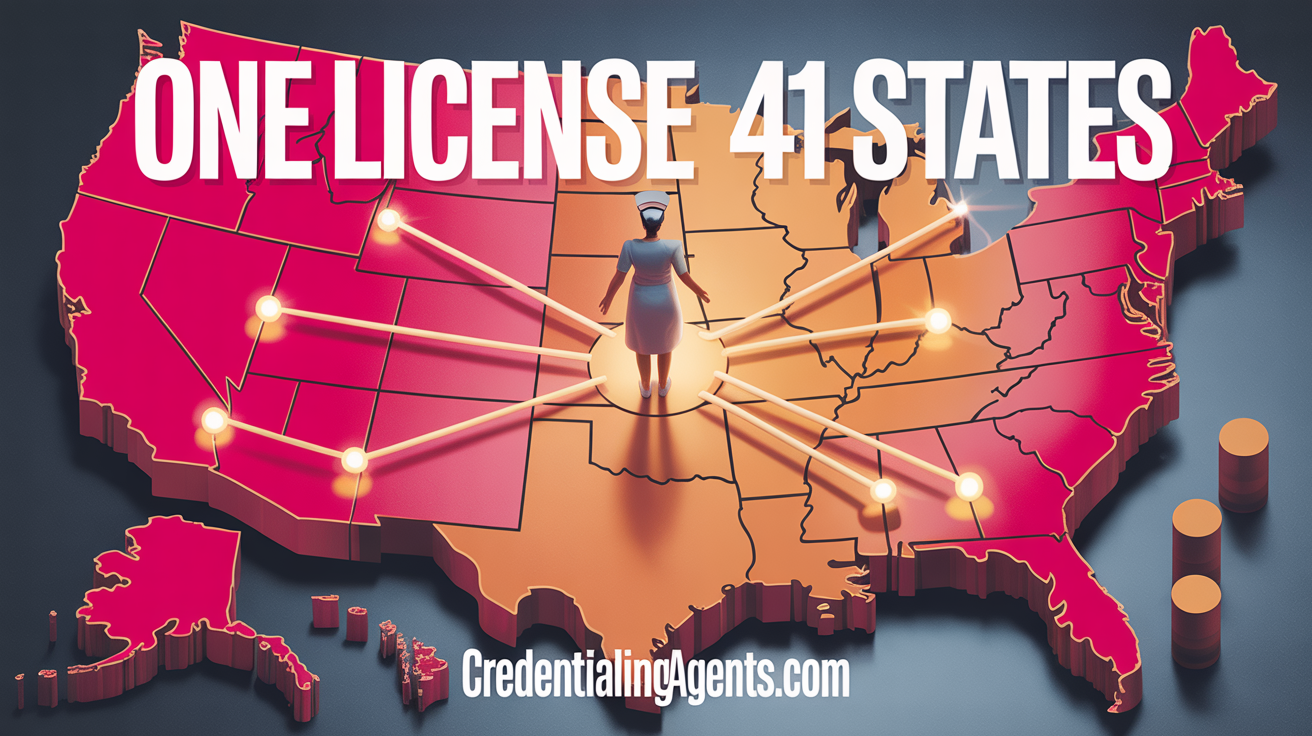
What it is: An agreement between 41 states that allows nurses with a compact license to practice in any member state.
Benefits:
- No need for multiple state licenses
- Faster assignment starts
- More flexibility for nurses
- Reduced credentialing complexity
Limitations:
- Not all states are members (CA, NY, MA notably absent)
- Must maintain primary residence in a compact state
- Still need facility-specific credentialing
Credentialing Timelines by Facility Type
| Facility Type | Typical Timeline | Key Challenges |
| Large hospital systems | 4-8 weeks | Committee schedules, VMS requirements |
| Community hospitals | 2-4 weeks | Limited staff, manual processes |
| Critical access | 1-3 weeks | Faster but inconsistent |
| Ambulatory/Outpatient | 1-2 weeks | Simpler requirements |
| Long-term care | 1-2 weeks | State survey compliance |
Common Travel Nurse Credentialing Mistakes
1. Starting Too Late
Mistake: Beginning credentialing after placement confirmation. Fix: Start credentialing during the interview process.
2. Incomplete Files
Mistake: Submitting files with missing documents. Fix: Use checklists and automated gap analysis.
3. Expired Credentials
Mistake: Not catching expired certifications until submission. Fix: Continuous monitoring with proactive alerts.
4. Wrong State Requirements
Mistake: Using generic checklists instead of state-specific ones. Fix: Build state-specific requirement profiles.
5. Poor Communication
Mistake: Nurses dont know their credentialing status. Fix: Real-time status portals and automated updates.
Technology Stack for Travel Nurse Credentialing
Modern agencies use:
- Credentialing software: BlueSky, Symplr, Modio
- VMS platforms: ShiftWise, Medefis, Stafferlink
- Document management: Secure cloud storage with OCR
- Verification services: NPDB, Nursys, state board APIs
- AI automation: Document extraction, follow-up automation
The Future: Portable Credentials
The industry is moving toward portable, digital credentials:
- Digital wallets: Nurses carry verified credentials on their phones
- Blockchain verification: Immutable credential records
- Real-time updates: Credentials verified instantly
- Universal acceptance: One credential file for all facilities
Struggling with travel nurse credentialing volume? See how AI agents can handle the heavy lifting.