The VMS Credentialing Bottleneck: Why Your Tech Stack Is Your Biggest Compliance Risk
The VMS Credentialing Bottleneck: Why Your Tech Stack Is Your Biggest Compliance Risk
Your credentialing team is drowning. Not in paperwork—that problem you solved years ago when you digitized your files. They're drowning in data fragmentation.
Every hospital system your agency works with runs a different Vendor Management System. ShiftWise. Medefis. AMN Passport. Wanderly. Each one demands credential data in a different format, through a different portal, with different refresh schedules.
And somewhere between your internal ATS, your credentialing database, and those 47 different VMS portals sits your compliance coordinator, manually copying and pasting the same nurse's license number for the fifteenth time this week.
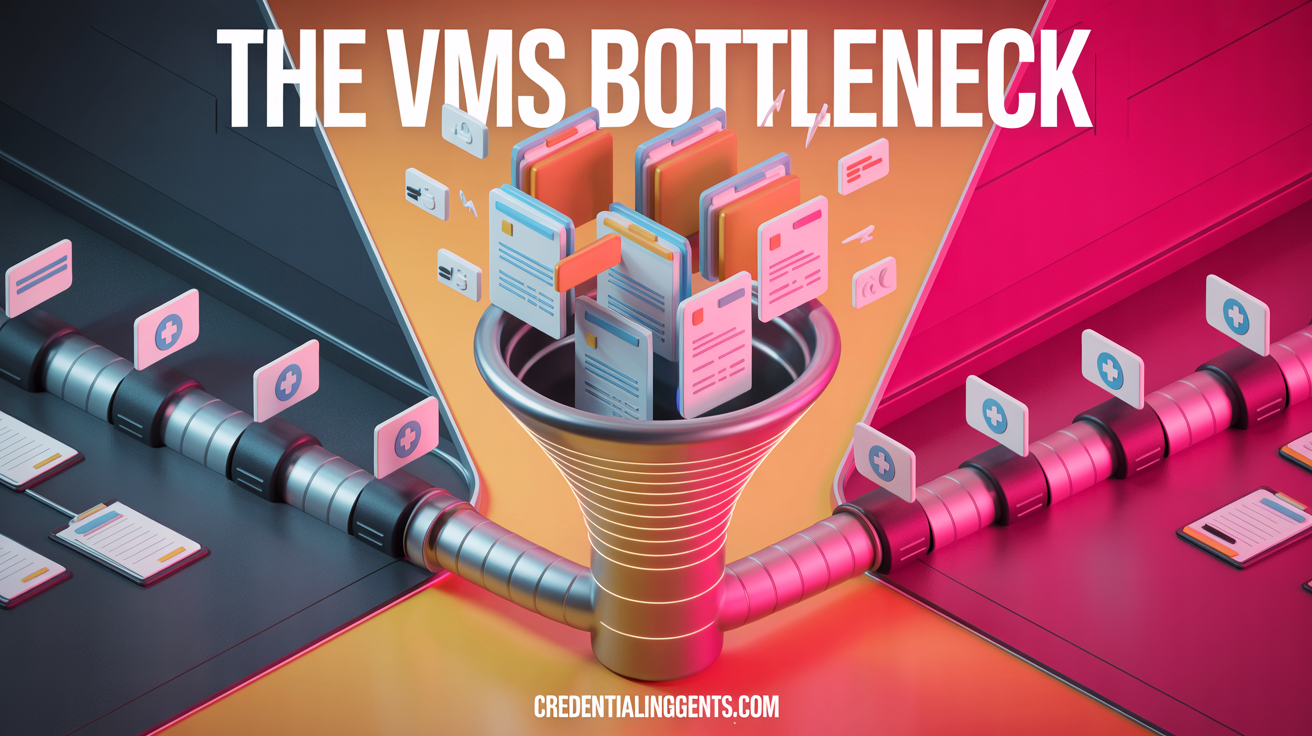
This is the VMS credentialing bottleneck. And it's costing you more than you think.
The Fragmentation Problem Nobody Talks About
Healthcare staffing agencies love to talk about credentialing speed. "We credential nurses in 72 hours!" Great. But what happens after that credential is verified?
It has to flow somewhere. Usually, it has to flow to multiple places:
- Your internal HR system
- Your applicant tracking system
- The hospital's VMS
- The hospital's credentialing committee portal
- Your compliance dashboard
- Your client's compliance dashboard
Every disconnected system is a potential compliance failure. Every manual re-entry is an opportunity for error. Every outdated portal sync is a Joint Commission finding waiting to happen.
What the VMS Leaders Know
Industry veterans like Tim Teague, who built BlueSky Medical Staffing's VMS platform, have been evangelizing integration for years. The message is consistent: credentialing isn't a standalone function—it's the connective tissue between your agency and every client you serve.
When your credential data doesn't flow automatically, you create three dangerous conditions:
1. Compliance Lag
A nurse's license expires. Your credentialing team catches it immediately. But the update doesn't propagate to the client's VMS for 48 hours. During that window, you've got an actively working clinician whose file shows expired credentials in the hospital's system.
That's not a paperwork problem. That's a compliance emergency.
2. Revenue Leakage
Every hour your team spends manually entering data into VMS portals is an hour they're not spending on revenue-generating activities. We've seen agencies with credentialing coordinators who spend 60% of their time on data entry rather than verification.
At an average fully-loaded cost of $65/hour, that's nearly $80,000 per credentialing coordinator per year spent on data transfer—not actual credentialing work.
3. Scalability Ceiling
You can't grow past your operational capacity. If adding 100 new clinicians means adding another full-time coordinator just to handle VMS data entry, your margins compress with every growth milestone.
The agencies winning market share right now aren't just fast at credentialing—they've solved the integration problem.
The Real Compliance Risk
Here's what keeps compliance officers up at night: Joint Commission doesn't care about your internal systems. They care about what's in the client's system at the time of audit.
If your internal records are perfect but the VMS shows outdated information, you've failed the audit. The hospital failed the audit. And your agency just became a liability instead of a partner.
What Modern Integration Looks Like
The solution isn't adding more people. It's automated credential data flow that:
- Pushes updates in real-time across all connected systems
- Validates data consistency before it reaches client portals
- Alerts on sync failures before they become compliance gaps
- Maintains audit trails showing exactly when and how data moved
This isn't futuristic technology. Agencies using AI-powered credentialing platforms have already solved this. The question is whether your agency is one of them.
The Competitive Divide
The healthcare staffing industry is splitting into two camps:
Camp A: Agencies still treating credentialing as an isolated back-office function. They're hiring more coordinators, building bigger Excel spreadsheets, and manually logging into 30 different VMS portals every morning.
Camp B: Agencies treating credentialing data as a competitive asset. They've integrated their systems. Their credential updates flow automatically. Their compliance posture is bulletproof.
Camp B is taking Camp A's clients.
Time to Audit Your Tech Stack
Ask yourself these questions:
- How many systems does a single credential touch before it reaches a client?
- What's the average lag time between an internal update and VMS reflection?
- How many hours per week does your team spend on manual data entry?
- When was the last time a sync failure caused a compliance gap?
If you don't like the answers, it's time to modernize.
Credentialing Agents eliminates the VMS bottleneck with AI-powered credentialing that integrates directly with your existing systems. Real-time verification. Automatic propagation. Zero manual data entry.
👉 See how it works at CredentialingAgents.com
The agencies that solve integration first will own the next decade of healthcare staffing. Will yours be one of them?