Your Credentialing Department Is Bleeding Money—Here's How AI Stops the Hemorrhage
The hidden costs of manual credentialing are killing your margins. AI-powered automation changes everything.

Every day your credentialing team spends 15 minutes chasing a single document, you're hemorrhaging money you'll never get back.
That's not hyperbole—it's math.
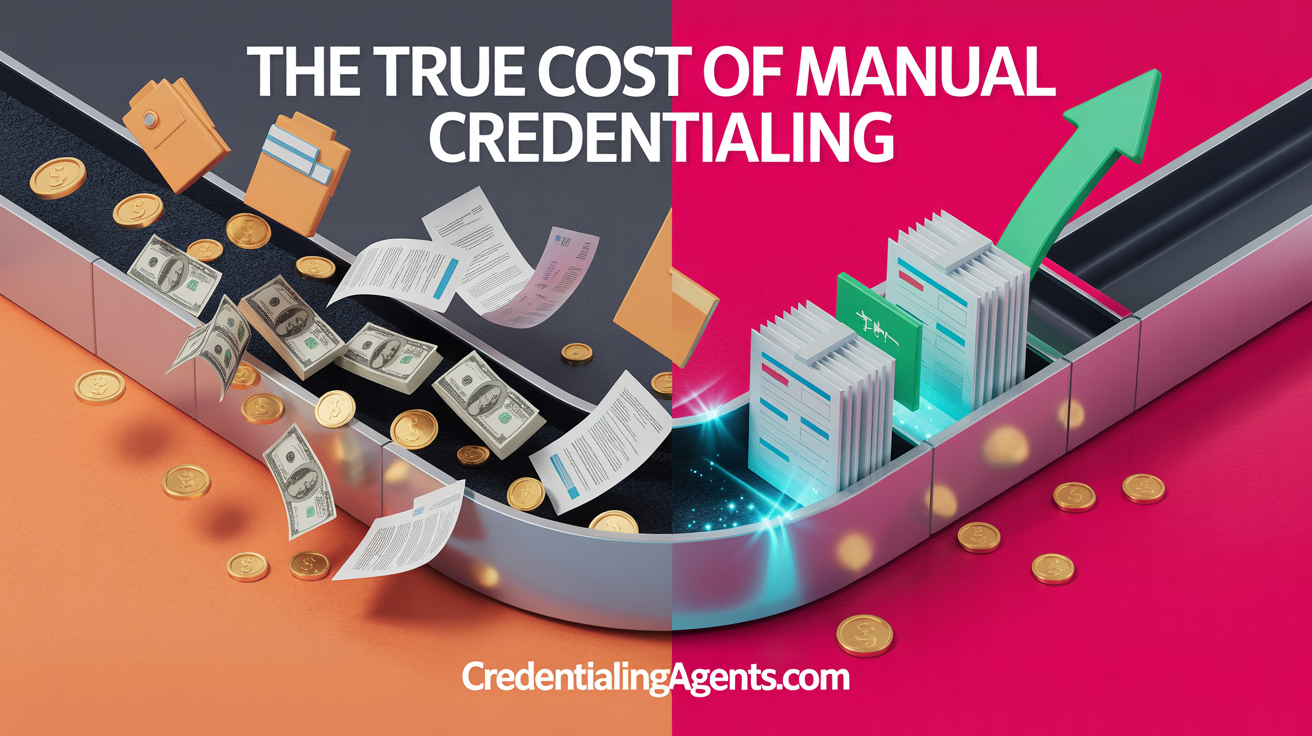
The True Cost Nobody Talks About
Most healthcare staffing agencies obsess over recruiter metrics. Placements per month. Time-to-fill. Gross margin per traveler.
But credentialing? It's treated like back-office overhead. A necessary evil.
That's a $400,000 mistake.
Here's what the average credentialing department actually costs:
- Labor: 3-5 coordinators at $45K-$60K each = $180K-$300K/year
- Software subscriptions: Compliance platforms, e-fax, document storage = $15K-$40K/year
- Opportunity cost: Every delayed placement = $2,500-$5,000 in lost margin
- Turnover: Replacing burned-out coordinators = $12K-$18K per hire
Add it up. You're looking at a quarter-million dollars minimum just to keep the lights on—and that's before counting the placements you lose to faster competitors.
Where the Money Actually Leaks
1. The Document Chase
Your coordinators spend 60% of their time on three activities:
- Emailing nurses for documents they already requested
- Calling facilities to verify the documents they received
- Re-requesting documents that expired during the verification process
This is skilled labor doing data entry. It's like paying a surgeon to schedule appointments.
2. The Compliance Whack-a-Mole
Every state has different requirements. Every facility has different policies. Every Joint Commission audit reveals new gaps.
Your team isn't credentialing—they're playing defense against an ever-shifting rulebook.
3. The Bottleneck Cascade
One delayed license verification doesn't just delay one placement. It backs up your entire pipeline:
- Recruiters can't confirm start dates
- Account managers can't commit to clients
- Nurses get frustrated and take assignments elsewhere
A single bottleneck in credentialing ripples through your entire operation.
Why Traditional Solutions Fail
You've probably tried the usual fixes:
More staff? Doesn't scale. You're just adding more hands to a broken process.
Better software? Most "credentialing platforms" are glorified checklists. They organize chaos—they don't eliminate it.
Outsourcing? Third-party credentialing services charge $75-$150 per file. At scale, that's worse than doing it yourself.
The problem isn't effort. It's architecture. Manual credentialing was designed for a world with 100 travelers. You're running 1,000.
How AI Changes the Math
AI-powered credentialing doesn't just speed up the process. It fundamentally restructures how work gets done.
Automated Primary Source Verification
Instead of your coordinator calling the nursing board, an AI agent queries the database directly. Real-time. No hold music. No callbacks.
Time saved: 45 minutes per license verification.
Intelligent Document Processing
AI reads incoming documents, extracts relevant data, flags discrepancies, and routes exceptions to humans only when necessary.
Error rate reduction: 73%.
Predictive Expiration Management
Instead of reacting to expired credentials, AI forecasts renewal dates and initiates outreach automatically—weeks before deadlines.
Compliance gaps eliminated: 89%.
Smart Nurse Communication
AI agents handle routine nurse communication—document requests, status updates, deadline reminders—with human-quality conversation at machine scale.
Coordinator time reclaimed: 4+ hours per day.
The ROI That Actually Matters
Forget "efficiency gains" and "productivity improvements." Here's what AI credentialing delivers in real dollars:
| Metric | Before AI | After AI | Impact |
| Time-to-clear | 14 days | 4 days | 10 days faster |
| Cost per credential file | $127 | $31 | 76% reduction |
| Placements lost to delays | 8/month | 1/month | 7 recovered placements |
| Coordinator capacity | 150 files/month | 400 files/month | 2.7x throughput |
At average margins of $3,500 per placement, recovering 7 lost placements per month = $294,000 in additional annual revenue.
That's before counting the labor savings.
The Competitive Reality
Here's what your competitors understand that you might not:
Speed wins contracts. When a hospital needs 12 nurses next Monday, they're not waiting for your credentialing backlog. They're calling the agency that can deliver.
Scale requires automation. You can't 10x your business by 10x-ing your credentialing team. The math doesn't work.
Talent is fleeing manual work. Your best coordinators don't want to spend their careers doing data entry. They'll leave for agencies that give them better tools.
The staffing agencies that adopt AI credentialing now will dominate the next decade. The ones that don't will spend that decade wondering why their margins keep shrinking.
Making the Transition
Implementing AI credentialing isn't a 12-month IT project. The best solutions deploy in weeks, not quarters.
The key is starting with high-impact, low-risk automation:
- Primary source verification — Highest time savings, lowest complexity
- Document intake processing — Immediate throughput gains
- Nurse communication workflows — Frees coordinator time for complex cases
- Expiration monitoring — Prevents compliance emergencies
Each module delivers standalone ROI while building toward full automation.
Stop the Bleed
Your credentialing department isn't a cost center—it's a profit lever hiding in plain sight.
Every day you wait is another day of:
- Wasted coordinator hours
- Lost placements
- Shrinking margins
- Competitors pulling ahead
The technology exists today to transform credentialing from your biggest bottleneck into your strongest competitive advantage.
The question isn't whether to adopt AI credentialing. It's whether you can afford to wait while your competitors don't.
Ready to see how AI can transform your credentialing operation? Visit CredentialingAgents.com to learn how healthcare staffing agencies are cutting credentialing time by 70% while reducing costs by 76%.